
Volume III
Panuel, AEG, UEI, and AFnecon: A New Architecture for African Economic Transformation
Africa’s development conversation has long been dominated by familiar themes. Governments debate economic reforms, businesses seek investment, development institutions finance infrastructure, policymakers pursue industrialization, and international organizations recommend improvements in governance, education, healthcare, and macroeconomic stability. Each initiative addresses an important part of the development process, yet many African economies continue to confront persistent structural challenges: low industrial productivity, inadequate infrastructure, limited capital formation, weak manufacturing, high unemployment, food insecurity, policy uncertainty, and insufficient integration into global value chains. The continent has no shortage of ideas, resources, or entrepreneurial talent. What it lacks is a unified economic architecture capable of connecting these elements into one productive system.
At its core, this is a structural challenge. Africa does not simply need more investment, more infrastructure, or more policies. It needs greater harmony among the institutions, industries, and capital systems that already exist. Development has often been approached as a collection of independent sectors, each pursuing its own objectives with limited coordination. Agriculture develops separately from logistics. Infrastructure develops separately from finance. Manufacturing grows independently of education. Governance reforms proceed independently of industrial policy. As a result, productive sectors frequently operate against one another rather than with one another. The visible outcome is economic underperformance, but the underlying reality is systemic friction.
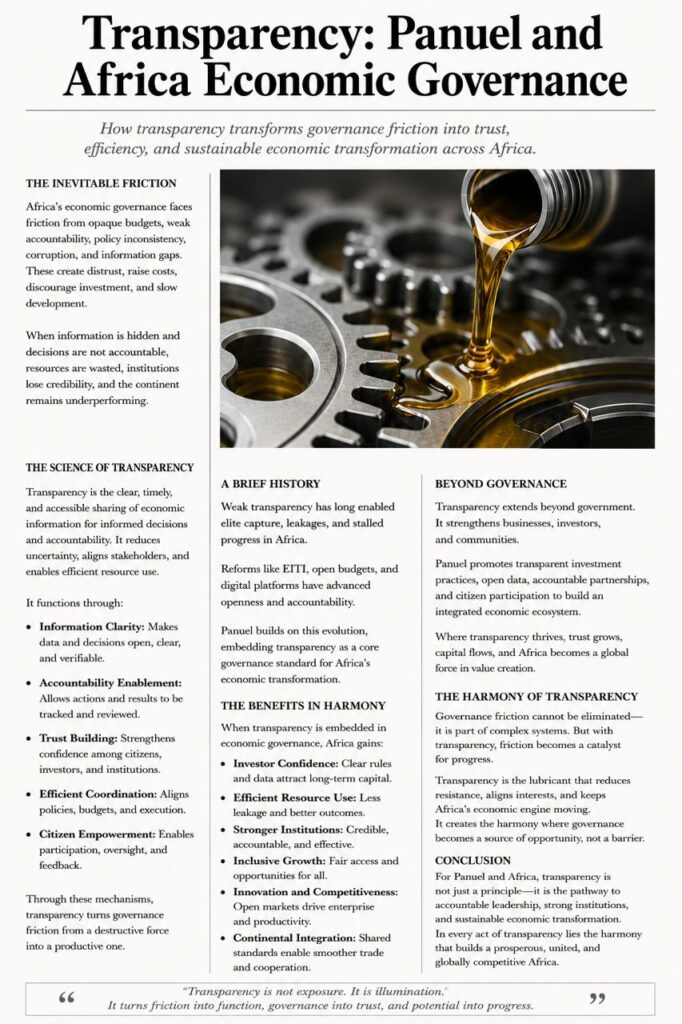
The previous volumes introduced a broader principle that extends far beyond engineering. Every productive system contains friction, and sustainable performance depends not on eliminating resistance entirely but on managing it intelligently. Lubrication preserves energy, reduces wear, improves efficiency, and extends productive life. Transparency performs this function within institutions by reducing uncertainty and strengthening trust. This final volume applies the same philosophy to Africa’s economic transformation. It argues that Africa’s future competitiveness depends upon building an integrated lubrication system for the continent’s productive economy. Rather than treating governance, infrastructure, finance, industrialization, and trade as isolated priorities, they should function as mutually reinforcing components of a single development architecture.
This philosophy forms the foundation of what I describe as Africa Economic Governance (AEG). Governance should no longer be viewed merely as political administration or public sector management. It should be understood as the operating system of an economy. Just as an operating system coordinates hardware, software, memory, and processing power within a computer, economic governance coordinates institutions, capital, infrastructure, markets, and productive activity. When governance functions effectively, resources move efficiently throughout the economy. When governance fails, friction increases, productive energy is wasted, and economic potential remains unrealized.
Within this framework, governance is not measured solely by elections, constitutional arrangements, or administrative procedures. Its effectiveness should be evaluated by its ability to reduce economic friction. Does it improve capital allocation? Does it strengthen investor confidence? Does it reduce transaction costs? Does it support industrial expansion? Does it encourage entrepreneurship? Does it increase productivity? These questions shift governance away from political rhetoric and toward measurable economic performance.
The first institutional lubricant within this architecture is Stability, Transparency, and Predictability (STP). Throughout modern economic history, investment has consistently flowed toward environments where businesses can plan with confidence. Stability reduces policy volatility. Transparency reduces information asymmetry. Predictability allows long-term decision-making. Together they lower institutional friction by reducing uncertainty. Investors require more than profitable opportunities; they require confidence that contracts will be enforced, regulations applied consistently, and macroeconomic conditions managed responsibly. STP therefore functions as one of the principal lubrication systems of capital formation. Without it, investment becomes cautious, expensive, and increasingly short-term. With it, capital moves more freely into productive enterprise, infrastructure, manufacturing, innovation, and industrial development.
However, attracting investment alone cannot transform an economy. Capital requires productive destinations capable of generating sustainable returns. This introduces the second major component of the architecture: Untapped Essential Industries (UEI). Every economy contains industries that quietly support every other sector while receiving comparatively little strategic attention. These industries form the productive foundation upon which broader economic activity depends. They include logistics, warehousing, construction, energy, maritime transportation, industrial equipment, storage systems, manufacturing support services, and numerous other sectors that rarely dominate public debate yet determine the efficiency of the entire economy.
UEI proposes that development should prioritize industries with the greatest multiplier effects across the broader productive system. Rather than investing only in highly visible sectors, policymakers should identify industries that reduce operational friction for thousands of businesses simultaneously. Modern ports lower logistics costs for exporters. Reliable electricity improves manufacturing competitiveness. Industrial parks reduce production costs. Efficient freight systems strengthen regional trade. Warehousing improves inventory management. Financial infrastructure improves capital allocation. These investments function like lubrication within machinery: they reduce resistance throughout the entire economic system rather than benefiting only individual sectors.
The third component addresses the foundation of everyday economic life. Africa Basic Economics (ABE) recognizes that sustainable development begins with food, transportation, and housing. These three sectors determine how much disposable income households retain after satisfying basic needs. When families spend excessive proportions of their income on food, transportation, and shelter, little remains for savings, investment, education, entrepreneurship, or wealth accumulation. Consequently, domestic capital formation weakens before industrialization can fully emerge.
ABE therefore argues that reducing the cost of basic necessities represents more than social policy. It is productive economic policy. Affordable food increases purchasing power. Efficient transportation expands labor markets while lowering business costs. Accessible housing strengthens household financial stability and encourages long-term asset accumulation. These improvements increase savings, strengthen domestic investment, and create broader consumer markets capable of supporting industrial expansion. Like lubrication, they reduce unnecessary resistance within the daily economic lives of millions of citizens.
These frameworks naturally converge within AFnecon, the Africa A Nation Economic initiative. AFnecon represents the continental expression of this philosophy. Its objective is not merely economic growth measured by gross domestic product, but structural transformation measured by productive capacity, industrial competitiveness, capital formation, technological advancement, and integration into global markets. It views Africa not as fifty-four isolated economies competing independently but as an increasingly interconnected production ecosystem capable of creating shared prosperity through coordinated development.
Under AFnecon, regional integration extends beyond tariff reduction. It includes coordinated infrastructure development, harmonized investment policies, integrated logistics networks, cross-border industrial clusters, energy cooperation, financial connectivity, digital commerce, and knowledge exchange. Every initiative seeks to reduce friction across continental markets, allowing goods, capital, information, technology, and talent to move more efficiently throughout Africa. The objective is not integration for its own sake but integration as a mechanism for increasing productivity and competitiveness.
Panuel Group serves as the practical business expression of this philosophy. Rather than operating as a collection of unrelated commercial activities, Panuel is designed as an integrated investment ecosystem in which each sector reinforces the others. Maritime logistics supports international trade. Infrastructure development expands productive capacity. Energy strengthens industrial performance. Financial services mobilize capital. Real estate supports long-term asset creation. Technology improves operational efficiency. International commerce connects African producers with global markets. Every business activity contributes toward reducing friction somewhere within the broader productive economy.
This integrated approach reflects an important economic principle. Wealth creation rarely occurs within isolated sectors. It emerges from connections between sectors. Modern economies become competitive because transportation connects manufacturing to markets, finance connects savings to investment, education connects knowledge to productivity, technology connects innovation to industry, and governance connects institutions to capital formation. Development therefore depends less upon individual projects than upon the quality of relationships linking those projects together.
This perspective also reshapes how Africa should compete globally. Competition in the twenty-first century increasingly occurs between economic systems rather than individual firms. Investors evaluate ecosystems. Manufacturers evaluate supply chains. Technology companies evaluate research environments. Financial institutions evaluate regulatory quality. Skilled professionals evaluate opportunities for innovation and career development. Countries therefore compete by building integrated systems capable of attracting, retaining, and expanding productive enterprise.
Artificial intelligence illustrates this changing reality. Global capital increasingly flows toward economies capable of combining technological innovation with reliable institutions, abundant energy, advanced digital infrastructure, skilled human capital, and predictable governance. Africa’s opportunity lies not merely in adopting new technologies but in creating institutional environments where technology can thrive alongside manufacturing, agriculture, logistics, finance, and infrastructure. The future belongs to economies that successfully integrate these systems rather than treating them as separate policy domains.
Ultimately, the Lubrication Theory of Economic Development proposes a different way of understanding prosperity. Nations do not become wealthy simply because they possess abundant resources or ambitious development plans. They become prosperous because they continuously reduce unnecessary friction within the systems that create value. Infrastructure reduces logistical friction. Finance reduces capital friction. Education reduces knowledge friction. Technology reduces production friction. Transparency reduces institutional friction. Governance reduces coordination friction. Together, these lubricants preserve productive energy that would otherwise be lost through inefficiency, uncertainty, fragmentation, and waste.
Africa’s transformation therefore depends not only on building more roads, attracting more investment, or implementing more reforms. It depends on designing an economic architecture in which every institution, industry, and investment works in harmony with every other. That harmony is the true lubricant of development. It transforms isolated progress into systemic progress, individual success into national competitiveness, and economic potential into sustainable prosperity.
This is the vision that underpins Panuel, AEG, UEI, ABE, STP, and AFnecon. They are not separate ideas competing for attention. They are complementary components of one integrated philosophy whose ultimate objective is to reduce the friction that has historically constrained Africa’s productive capacity. When that friction is systematically reduced, capital moves more efficiently, industries expand more rapidly, institutions perform more effectively, and prosperity becomes increasingly sustainable.
The future of Africa will not be determined solely by the resources beneath its soil or the size of its population. It will be determined by how effectively it designs the systems that convert those resources and that population into productive capacity, industrial competitiveness, innovation, and long-term wealth. Just as lubricant quietly enables every great machine to perform at its highest potential, effective economic governance quietly enables nations to move farther, faster, and more efficiently toward enduring prosperity. That is the harmony Africa must deliberately engineer.
Leave a Reply