Author: paulcudeh

  • Transparency: The Institutional Lubricant

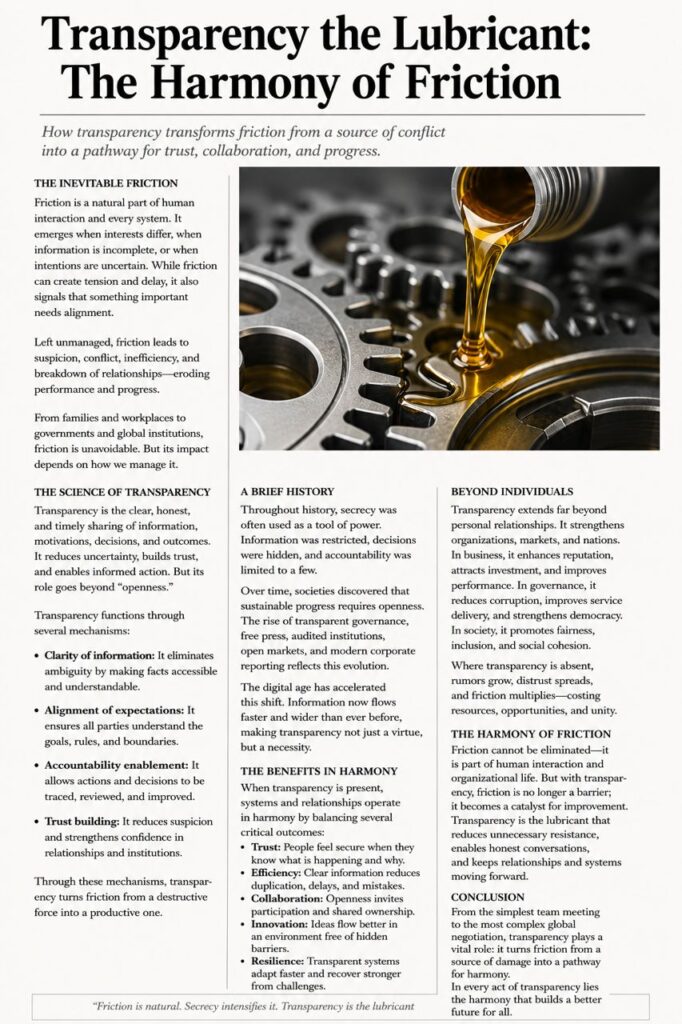
    Transparency: The Institutional Lubricant

    Volume II

    How Transparency Converts Economic Friction into Capital Formation

    Every investor understands a fundamental principle of finance: capital dislikes uncertainty. Regardless of the size of a market, the abundance of natural resources, or the promise of future growth, investment ultimately follows confidence. Investors continuously ask a simple question before committing capital: Can this environment be trusted? The answer determines not only where capital flows, but also how long it remains, how productively it is deployed, and whether it expands into future investment.

    For decades, economists have explained investment decisions through familiar variables such as interest rates, taxation, inflation, exchange rates, labor costs, and infrastructure quality. These factors undoubtedly matter because they directly influence business profitability. Yet beneath each of these variables lies a more fundamental institutional condition that determines whether markets function efficiently. That condition is transparency.

    Transparency is frequently discussed as an ethical principle or a governance objective. Governments promise transparency during elections. International organizations advocate transparent institutions. Corporations publish transparency reports. Civil society campaigns for greater transparency in public finance and procurement. While these discussions remain important, they often overlook transparency’s deeper economic function. Transparency is not merely a democratic value; it is productive infrastructure. It performs within institutions the same role that lubricant performs within machines.

    The issue extends far beyond the surface.

    In mechanical engineering, lubricant reduces friction between moving surfaces, preserving energy that would otherwise be wasted through unnecessary resistance. It separates components, minimizes wear, carries away heat, prevents corrosion, and allows machinery to operate efficiently under pressure. Without lubrication, engines overheat, bearings deteriorate, components seize, and productive systems eventually fail despite possessing sufficient mechanical power.

    Institutional systems behave remarkably similarly.

    Every economy contains friction. Governments formulate policies. Businesses negotiate contracts. Banks allocate credit. Investors evaluate opportunities. Regulators supervise markets. Entrepreneurs establish enterprises. Citizens interact with public institutions. These countless interactions collectively determine economic performance. Yet unlike physical friction, institutional friction often remains invisible. It appears through incomplete information, opaque decision-making, inconsistent regulations, unreliable financial reporting, hidden liabilities, policy reversals, bureaucratic delays, corruption, and uncertainty regarding future government actions.

    Transparency functions as the lubricant that reduces this institutional resistance.

    This perspective fundamentally changes how transparency should be understood. Rather than viewing transparency as simply publishing more information, we should understand it as a system that preserves productive economic energy. It reduces unnecessary resistance, allowing capital, ideas, entrepreneurship, and innovation to move more efficiently throughout the economy.

    Economic development rarely occurs by accident; it is often the result of deliberate strategy.

    History demonstrates that successful economies consistently strengthen transparency alongside industrialization. The expansion of double-entry accounting during Renaissance Europe dramatically improved commercial trust by making business transactions verifiable. The emergence of audited financial statements strengthened investor confidence during the Industrial Revolution. Securities regulation expanded during the twentieth century because modern financial markets required transparent disclosure to allocate capital efficiently. Today, international accounting standards, corporate governance frameworks, central bank communication, open procurement systems, and digital government platforms all serve one essential function: reducing institutional friction.

    This observation aligns closely with institutional economics. The Nobel Prize-winning economist Douglass North argued that institutions reduce uncertainty by providing stable structures for human interaction. Likewise, the World Bank consistently identifies transparency, accountability, and institutional quality as central determinants of investment confidence and economic development. The Organisation for Economic Co-operation and Development similarly argues that transparent institutions reduce transaction costs, improve resource allocation, and strengthen market efficiency by lowering information asymmetry between economic actors. (North, 1990; World Bank, 2024; OECD, 2023).

    Information asymmetry represents one of the most important forms of institutional friction.

    Markets function efficiently only when participants possess reasonably equal access to reliable information. Investors require credible financial statements before purchasing securities. Banks evaluate accurate borrower information before extending loans. Businesses analyze regulatory environments before expanding production. Consumers compare products before making purchasing decisions. Governments rely upon accurate statistics before designing economic policy.

    When information becomes incomplete, unreliable, delayed, or intentionally concealed, uncertainty increases.

    That uncertainty behaves exactly like mechanical friction.

    Businesses postpone investment because risks cannot be measured accurately. Financial institutions increase lending rates to compensate for uncertainty. Investors demand higher returns before committing capital. Insurance premiums rise. Due diligence becomes more expensive. Contracts become increasingly complex. Economic energy that should support productivity instead becomes consumed overcoming informational resistance.

    Transparency reverses this process.

    Reliable information allows markets to price risk more accurately. Investors distinguish productive opportunities from speculative ones. Governments allocate public resources more efficiently. Financial institutions evaluate creditworthiness with greater confidence. Entrepreneurs identify emerging market opportunities more quickly. Consequently, transparency lowers the cost of capital while simultaneously improving the efficiency of capital allocation.

    This principle explains why transparency attracts investment independently of market size.

    Consider two economies possessing comparable populations, natural resources, infrastructure, and growth prospects. One consistently publishes reliable macroeconomic statistics, maintains transparent procurement systems, enforces accounting standards, communicates policy clearly, and operates predictable regulatory institutions. The other exhibits opaque budgeting, inconsistent reporting, hidden fiscal liabilities, irregular policy communication, and limited institutional disclosure.

    Although both economies possess similar productive potential, investors typically assign different risk premiums because transparency significantly influences confidence. Capital therefore becomes cheaper within transparent systems and more expensive within opaque systems. The difference is not simply perception; it represents measurable economic value created through institutional lubrication.

    Transparency also strengthens accountability.

    Machines operate efficiently because engineers continuously monitor temperature, pressure, vibration, lubrication quality, and mechanical performance. Without monitoring, small failures gradually become catastrophic failures.

    Institutions require similar feedback systems.

    Transparent governance exposes performance. Public expenditure becomes measurable. Budget implementation becomes observable. Regulatory decisions become reviewable. Corporate management becomes accountable to shareholders. Financial institutions become accountable to depositors. Political leaders become accountable to citizens.

    Transparency therefore performs a preventive function rather than merely a corrective one.

    Instead of discovering failures after substantial damage occurs, transparent systems identify emerging problems while corrective action remains relatively inexpensive.

    This preventive capability becomes increasingly important for long-term economic development.

    Corruption, for example, flourishes where institutional visibility remains limited. Procurement fraud, hidden public liabilities, regulatory capture, tax evasion, illicit financial flows, and administrative abuse all depend upon informational opacity. Transparency disrupts these activities not primarily through punishment but by increasing the probability that misconduct becomes observable.

    This distinction is critical.

    Transparency does not eliminate corruption entirely, just as lubrication does not eliminate friction entirely.

    Instead, it changes the operating environment.

    Unproductive behavior becomes more difficult.

    Productive behavior becomes more rewarding.

    Consequently, institutional energy increasingly flows toward value creation rather than value extraction.

    Transparency also strengthens financial markets.

    Modern capital markets depend upon trust. Investors purchase securities because they believe financial statements accurately represent underlying economic performance. Banks mobilize savings because depositors trust regulatory supervision. Businesses issue bonds because investors trust legal enforcement. Stock exchanges operate because market participants trust disclosure requirements.

    Without transparency, trust gradually deteriorates.

    Without trust, liquidity declines.

    Without liquidity, capital formation weakens.

    Without capital formation, industrial development slows.

    The entire productive economy ultimately bears the cost.

    For developing economies, transparency becomes even more significant.

    Emerging markets frequently compete for limited international capital against advanced economies possessing mature institutions. Investors evaluating these opportunities cannot directly observe every aspect of institutional quality. Instead, they rely heavily upon signals generated through transparency.

    Consistent statistical reporting signals institutional competence.

    Independent central bank communication signals monetary credibility.

    Transparent public procurement signals governance quality.

    Reliable financial disclosure signals corporate integrity.

    Open regulatory consultation signals policy predictability.

    Each reduces uncertainty.

    Each lowers institutional friction.

    Each attracts productive investment.

    This insight naturally complements the broader framework introduced in Volume I.

    If lubricant represents the universal principle of reducing unnecessary resistance within productive systems, then transparency represents one of the most powerful institutional lubricants available to modern economies.

    It preserves confidence.

    Improves coordination.

    Strengthens accountability.

    Reduces information asymmetry.

    Encourages investment.

    Improves capital allocation.

    Supports innovation.

    Enhances productivity.

    Extends institutional durability.

    Like lubricant within an engine, transparency rarely receives attention when functioning effectively. Investors seldom praise transparent procurement systems or reliable statistical agencies during periods of normal economic performance. Yet once transparency deteriorates, institutional friction increases rapidly. Investment slows. Confidence declines. Capital becomes more expensive. Economic efficiency weakens. Only then does society fully recognize the extraordinary value that transparency quietly provided.

    Ultimately, transparency should no longer be understood merely as a governance slogan.

    It is economic infrastructure.

    It is investment infrastructure.

    It is institutional lubrication.

    Just as machines cannot sustain productive motion without effective lubrication, economies cannot sustain long-term capital formation without transparent institutions capable of reducing unnecessary friction.

    The world’s most competitive economies are rarely those possessing the greatest quantity of natural resources. They are increasingly those possessing the highest quality of institutional lubrication. Transparency transforms uncertainty into confidence, confidence into investment, investment into productive capacity, and productive capacity into long-term prosperity.

    That is the harmony of transparency. It does not eliminate friction. It transforms friction into productive coordination, allowing economies to move farther, faster, and more efficiently toward sustainable development.

  • Lubricant: The Harmony of Friction

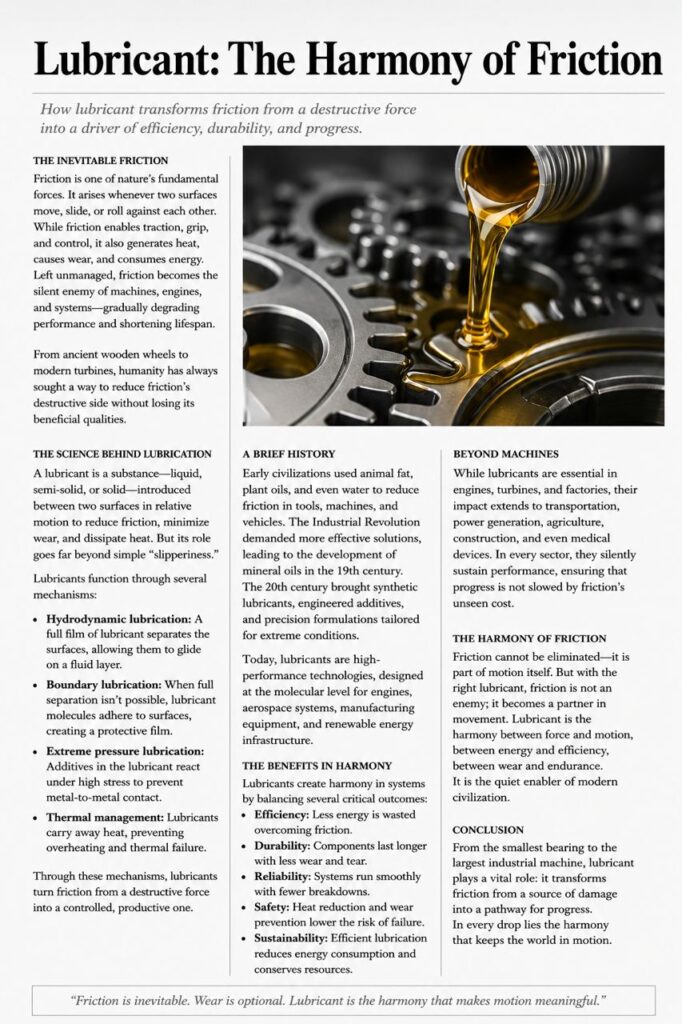
    Lubricant: The Harmony of Friction

    Volume I

    A Universal Theory of Productive Systems

    Every productive system in existence operates under one universal law: movement creates friction. Whether in physics, engineering, biology, economics, finance, business, or governance, no system can generate motion, perform work, or create value without encountering resistance. Friction is therefore neither an accident nor an imperfection. It is a natural consequence of interaction. The challenge facing every system is not how to eliminate friction altogether, but how to manage it intelligently.

    This simple engineering principle has shaped human civilization for thousands of years. Long before the Industrial Revolution transformed manufacturing, ancient civilizations recognized that reducing unnecessary friction improved productivity. Early builders lubricated sledges to move enormous stones. Farmers reduced resistance between tools and soil. Mill operators understood that properly maintained bearings allowed machinery to operate longer with less energy. Engineers eventually developed increasingly sophisticated lubricants capable of reducing wear, dissipating heat, protecting surfaces, and extending the lifespan of machines operating under extraordinary pressure. Today, modern civilization depends upon lubrication systems that quietly sustain automobiles, aircraft, power plants, factories, ships, turbines, robots, and countless industrial processes.

    Yet while humanity has mastered the science of lubrication in machines, it has devoted comparatively little attention to applying the same principle to organizations, economies, financial markets, governments, and societies. This paper proposes that the concept of lubrication extends far beyond mechanical engineering. It represents a universal framework for understanding how productive systems sustain efficiency, preserve value, and achieve long-term resilience. In this broader sense, lubricant becomes more than a physical substance. It becomes a philosophy of productive systems.

    The issue extends far beyond the surface.

    When engineers study friction, they recognize that it performs two seemingly contradictory functions. On one hand, friction is indispensable. Without friction, vehicles cannot accelerate, aircraft cannot land safely, machinery cannot transfer power, and people cannot even walk. Friction enables traction, control, precision, and stability. On the other hand, unmanaged friction consumes energy, generates excessive heat, accelerates wear, shortens equipment life, increases maintenance costs, and ultimately leads to system failure. The engineering objective has therefore never been to abolish friction entirely. Rather, it has been to preserve useful friction while minimizing destructive friction.

    This distinction offers profound lessons for economics and institutional development.

    Every productive economy contains friction. Markets involve negotiation. Businesses manage competition. Investors evaluate uncertainty. Governments administer regulations. Financial institutions assess risk. Supply chains coordinate thousands of interconnected activities across multiple countries. None of these systems operate without resistance. The question is not whether friction exists. The question is whether that friction contributes to productive coordination or unnecessary inefficiency.

    Mechanical engineering provides remarkable clarity on this principle. Lubricants operate by separating moving surfaces, reducing direct contact, minimizing wear, carrying away heat, preventing corrosion, and maintaining stable operating conditions. These functions preserve energy that would otherwise be wasted overcoming unnecessary resistance. Consequently, machines operate more efficiently, consume less energy, require fewer repairs, and produce greater output over longer periods.

    Economies exhibit remarkably similar behavior.

    Consider two manufacturing firms producing identical products using comparable technologies. One operates within an environment characterized by transparent regulations, reliable electricity, efficient logistics, accessible financing, predictable taxation, and trustworthy institutions. The other operates where regulations change unpredictably, infrastructure remains unreliable, corruption increases transaction costs, financing is prohibitively expensive, contracts are inconsistently enforced, and information remains opaque. Although both firms possess similar productive capabilities, their performance differs substantially because one operates within a well-lubricated institutional environment while the other continually loses productive energy overcoming systemic friction.

    From an economic perspective, this wasted energy appears as higher operating costs, delayed investment, reduced competitiveness, slower innovation, declining productivity, and weaker profitability. Resources that should finance expansion instead finance adaptation. Time that should support innovation becomes consumed managing uncertainty. Capital that should purchase new equipment becomes diverted toward overcoming institutional obstacles. The system continues functioning, but far below its productive potential.

    Economic development rarely occurs by accident; it is often the result of deliberate strategy.

    Throughout history, successful civilizations have consistently reduced unnecessary friction within productive systems. The Roman Empire developed standardized roads that lowered transportation costs across vast territories. The Industrial Revolution introduced interchangeable parts, standardized manufacturing, and increasingly sophisticated machinery that dramatically improved industrial efficiency. The twentieth century witnessed containerization, computerized logistics, global telecommunications, and digital financial systems, each reducing friction within international trade. More recently, artificial intelligence promises to reduce decision-making costs, optimize supply chains, improve resource allocation, and increase productivity across virtually every sector of the global economy.

    Each innovation shares a common objective.

    Reduce friction.

    Increase productive motion.

    Preserve valuable energy.

    This observation suggests that economic progress itself can be understood as the continuous reduction of unnecessary resistance within productive systems.

    Businesses intuitively recognize this principle. Companies invest heavily in process optimization because operational friction directly reduces profitability. Manufacturers redesign production lines to eliminate inefficiencies. Financial institutions automate transactions to reduce administrative delays. Logistics companies optimize delivery routes to minimize transportation costs. Software developers simplify user interfaces to reduce customer effort. Hospitals streamline patient workflows. Universities digitize administrative processes. Every organization seeking higher productivity ultimately attempts to identify and remove unnecessary friction.

    National economies operate similarly.

    Infrastructure functions as a lubricant because it reduces transportation resistance. Financial systems lubricate capital allocation by connecting savings with productive investment. Legal institutions lubricate commerce through contract enforcement. Education lubricates innovation by strengthening human capital. Technology lubricates production through automation and efficiency. Stable monetary systems lubricate exchange by preserving purchasing power. Transparent governance lubricates investment by reducing uncertainty. Each performs a distinct function, yet all contribute toward the same objective: allowing productive activity to occur with fewer unnecessary obstacles.

    Conversely, corruption behaves like abrasive contamination within machinery. Instead of reducing friction, it increases it. Businesses devote additional resources to navigating opaque procedures. Investors incorporate higher risk premiums into financial decisions. Public projects become more expensive while producing lower-quality outcomes. Institutional trust deteriorates. Productive energy dissipates through inefficiency rather than value creation. Like contaminated lubricant within an engine, corruption gradually accelerates institutional wear until the system itself becomes increasingly unreliable.

    This analogy extends even further.

    Machines require periodic maintenance because lubricants degrade over time. Economic institutions require continual reform for precisely the same reason. Laws become outdated. Regulations lose effectiveness. Infrastructure deteriorates. Technologies evolve. Global markets change. Without institutional renewal, friction gradually accumulates until productivity declines despite unchanged productive capacity. Nations that consistently modernize institutions maintain smoother economic operation than those allowing institutional deterioration to continue unchecked.

    Investment itself can also be interpreted through this framework.

    Professional investors continuously seek environments where productive energy encounters minimal unnecessary resistance. They evaluate infrastructure quality, legal certainty, regulatory consistency, governance standards, financial stability, technological capability, and workforce productivity because each influences the amount of friction businesses must overcome before generating returns. Investors rarely describe this process using engineering terminology, yet their behavior reflects precisely the same principle. Capital flows toward well-lubricated systems.

    This observation fundamentally changes how competitiveness should be understood.

    Competitiveness is not merely determined by lower wages, larger markets, or abundant natural resources. It increasingly depends upon the degree of institutional friction embedded within an economy. Two countries may possess identical resource endowments, similar populations, and comparable market sizes, yet produce dramatically different economic outcomes because one has systematically reduced unnecessary resistance while the other continues operating within highly inefficient institutional structures.

    The implications become especially important for developing economies.

    Many countries possess extraordinary entrepreneurial talent, abundant natural resources, expanding consumer markets, and favorable demographic conditions. Yet these advantages alone cannot guarantee prosperity if productive systems remain burdened by excessive friction. Entrepreneurs struggle despite promising ideas. Manufacturers remain internationally uncompetitive despite abundant labor. Infrastructure projects exceed budgets while delivering limited performance. Financial systems fail to allocate capital efficiently. Public institutions consume increasing resources while producing declining effectiveness. Productive potential exists, but friction prevents its realization.

    This insight forms the foundation of what I call The Lubrication Theory of Economic Development.

    The theory proposes that sustainable economic transformation depends not merely upon increasing resources but upon continuously reducing unnecessary friction across productive systems. Development therefore becomes the process of identifying where resistance destroys value and designing institutions capable of managing that resistance more intelligently. Just as lubrication allows machines to preserve energy for productive work, effective institutions preserve economic energy for innovation, investment, industrialization, entrepreneurship, and wealth creation.

    Ultimately, civilization itself can be interpreted through this lens. Every major advancement—from the invention of the wheel to modern artificial intelligence—has reduced friction somewhere within the human productive system. Roads reduced transportation friction. Electricity reduced production friction. Telecommunications reduced information friction. Banking reduced financial friction. The internet reduced communication friction. Artificial intelligence now promises to reduce cognitive friction. Human progress has consistently advanced through the intelligent management of resistance.

    Friction is therefore not the enemy of progress.

    Unmanaged friction is.

    Likewise, lubricant is far more than a mechanical substance. It represents one of humanity’s most important organizational principles. It transforms resistance into coordination, preserves productive capacity, extends system life, improves efficiency, and enables continuous motion under pressure. Whether applied to machines, businesses, financial markets, governments, or entire economies, the principle remains remarkably consistent.

    The world’s most successful systems are rarely those that eliminate friction entirely. They are the ones that understand it, manage it, and transform it into productive movement. That, ultimately, is the harmony of friction.

  • The Rate of Africa’s Economic Depreciation Against Public Opinion

    The Rate of Africa’s Economic Depreciation Against Public Opinion

    Measuring Africa’s Economic Appreciation and Depreciation: An STP Framework for Understanding the Continent’s Economic Future

    Social media has become one of the loudest commentators on Africa’s economic future. On one side are persistent narratives portraying the continent as an economy trapped in perpetual decline, defined by corruption, debt, inflation, political instability, and institutional weakness. On the other side are equally optimistic narratives describing Africa as the world’s inevitable next investment frontier, driven by its youthful population, abundant natural resources, rapid urbanization, and expanding consumer markets. Both perspectives attract considerable attention because they simplify a far more complex economic reality. Yet neither provides a reliable framework for understanding the continent’s actual economic trajectory.

    Economic appreciation and depreciation are not determined by public opinion, media headlines, or viral social media narratives. They are determined by measurable structural conditions that either strengthen or weaken an economy’s ability to create wealth, attract investment, expand productive capacity, and improve living standards over time. A country’s economy appreciates when productivity rises, institutions strengthen, investment confidence improves, industrial capacity expands, and capital is allocated efficiently toward productive enterprise. Conversely, an economy depreciates when inflation erodes purchasing power, unemployment wastes human capital, currencies weaken, investment declines, institutions lose credibility, and productive sectors fail to expand.

    This article proposes Stability, Transparency, and Predictability (STP) as a practical framework for measuring Africa’s rate of economic appreciation or depreciation. Unlike conventional indicators that examine inflation, GDP growth, or exchange rates independently, STP evaluates the institutional conditions that determine whether capital chooses to enter, remain within, or exit an economy. Stability measures the consistency of macroeconomic policy, political institutions, fiscal management, and monetary credibility. Transparency measures the openness, accountability, and integrity of both public and private institutions, reducing information asymmetry and lowering investment risk. Predictability measures whether businesses, investors, entrepreneurs, and households can make long-term decisions with confidence that policies, regulations, and institutions will remain reasonably consistent.

    Within this framework, inflation becomes more than rising prices; it represents the erosion of purchasing power and confidence in monetary stability. Currency depreciation extends beyond exchange rates because it raises import costs, increases debt-servicing burdens, discourages investment, and weakens industrial competitiveness. High unemployment reflects not merely labor market weakness but the underutilization of productive human capital. Elevated interest rates signal the increasing cost of capital, slowing entrepreneurship, industrial expansion, and long-term investment. Limited access to finance traps millions of entrepreneurs within survival activities rather than allowing them to build scalable enterprises capable of generating employment and innovation.

    Infrastructure deficits similarly represent more than physical shortages. Inadequate transport systems increase logistics costs, unreliable electricity constrains manufacturing, weak digital infrastructure limits technological adoption, and insufficient ports reduce export competitiveness. Policy inconsistency compounds these challenges by increasing uncertainty for investors, while corruption diverts financial resources away from productive sectors toward rent-seeking activities that generate private wealth without corresponding national productivity. Insecurity further increases business risk by raising insurance costs, discouraging investment, disrupting supply chains, and reducing labor mobility. Collectively, these variables determine the rate at which an economy either appreciates or depreciates.

    Economic appreciation begins when these pressures reverse. Inflation stabilizes, currencies strengthen, investment confidence improves, institutions become more transparent, infrastructure expands, industrial productivity rises, and entrepreneurship gains greater access to affordable capital. Businesses invest because future conditions become more predictable. Domestic savings increasingly finance productive enterprise rather than speculative activities. Manufacturing expands, exports become more competitive, and technological innovation strengthens productivity. These improvements reinforce one another, creating cumulative growth rather than isolated progress.

    The global economy introduces another important dimension to this analysis. Capital is increasingly mobile, constantly evaluating opportunity costs across industries and regions. Today, unprecedented volumes of global investment are flowing toward artificial intelligence, semiconductors, cloud infrastructure, advanced computing, biotechnology, renewable energy, and other frontier technologies. Consequently, African economies are no longer competing solely against neighboring countries for investment. They are increasingly competing against entire industries that promise higher productivity, greater scalability, and stronger long-term returns. This reality makes institutional quality even more important. Global capital increasingly follows technological leadership, credible governance, macroeconomic stability, and scalable opportunities capable of generating sustainable value.

    From this perspective, Africa’s future should not be evaluated through optimism or pessimism but through institutional performance. Social media narratives may shape perceptions, but investors allocate capital according to measurable economic realities. Nations that strengthen Stability, Transparency, and Predictability improve their ability to attract, retain, and productively deploy domestic and international capital. Those that fail to strengthen these foundations experience slower capital formation, weaker industrialization, reduced competitiveness, and declining investment confidence regardless of public narratives.

    Ultimately, Africa’s economic future cannot be measured by headlines alone. It must be measured by the strength of its institutions, the credibility of its policies, the productivity of its industries, and the confidence it inspires among investors, entrepreneurs, and citizens alike. The continent’s appreciation or depreciation is therefore not predetermined. It is a reflection of deliberate economic choices. Through the STP framework, Africa can move beyond speculation and begin measuring what truly matters: its capacity to transform stability, transparency, and predictability into productive investment, industrial expansion, and long-term prosperity.

  • UEI: The Coordinator of the African Eagles Economy

    UEI: The Coordinator of the African Eagles Economy

    Building Africa’s $10 Trillion Essential Economy Through the Untapped Essential Industries

    Every great civilization has been remembered not because of the wealth it possessed, but because of the systems it built. Wealth is often the outcome of productive systems rather than their starting point. Nations that transformed themselves into global economic powers did not begin with prosperity. They began by deliberately constructing the industries that make prosperity possible. Before factories produced exports, electricity powered machines. Before financial markets expanded, institutions mobilized capital. Before technology companies emerged, education produced skilled citizens. Before international trade flourished, transportation connected producers to markets. Economic success has never been accidental. It has always been coordinated.

    For decades, Africa’s development conversation has largely revolved around individual projects, foreign aid, natural resources, infrastructure construction, and economic reforms. These initiatives have undoubtedly contributed to progress, yet they often operate independently of one another. Roads are built without corresponding industrial zones. Universities produce graduates who struggle to find productive industries. Financial institutions expand while manufacturing remains undercapitalized. Governments invest in agriculture without creating efficient logistics systems capable of transporting products to domestic and international markets. Each sector moves forward, but too often it moves alone. The result is an economy that grows in fragments instead of functioning as one integrated system.

    The challenge facing Africa is therefore not simply insufficient investment or inadequate natural resources. The continent possesses abundant minerals, fertile agricultural land, strategic maritime routes, an expanding digital economy, and the world’s youngest workforce. The challenge is coordination. Development has frequently been approached as a collection of independent projects rather than as a unified economic architecture in which every strategic industry strengthens every other industry. Without coordination, even significant investment produces only limited long-term transformation.

    This realization inspired what I describe as the Untapped Essential Industries (UEI). UEI is not another industrial policy, another government programme, or another infrastructure agenda. It is a continental economic framework that identifies the foundational industries every African nation must intentionally strengthen because they collectively determine the productive capacity of the entire economy. Rather than asking which industry deserves the highest priority, UEI asks a more fundamental question: Which industries make every other industry possible?

    The answer forms what I describe as Africa’s Essential Economy. This is the productive layer of the economy that quietly sustains every business, every institution, every household, and every investment. It is the economy that supplies clean water before factories begin production. It generates electricity before machines operate. It constructs roads before commerce expands. It finances entrepreneurs before companies emerge. It educates citizens before innovation becomes possible. It provides housing before cities become productive. It develops transportation before trade can connect markets. It extends digital infrastructure before knowledge economies can compete globally. These industries rarely dominate newspaper headlines, yet every successful economy depends upon them every single day.

    UEI organizes this essential economy around twelve foundational industries: water supply, electricity supply, food security, road networks, housing development, automobile production supported by vehicle financing and insurance, financing systems, commerce and retail, education, internet and digital access, global and regional trade, and integrated transportation systems represented through the broader NexAfrica vision. Individually these industries appear familiar. Collectively they form something much larger. They become the productive foundation upon which industrialization, innovation, employment, and long-term prosperity are built.

    This is why I describe UEI as the Coordinator of the African Eagles Economy. Every economy contains numerous sectors competing for investment, policy attention, and public resources. Without coordination these sectors often develop unevenly, creating bottlenecks that limit national productivity. Reliable electricity without transportation still restricts manufacturing. Strong universities without functioning financial systems fail to commercialize innovation. Efficient ports without productive industries reduce trade to the export of raw materials. Housing without employment creates expanding cities without expanding prosperity. Economic development therefore requires more than investment. It requires strategic coordination among the industries that support one another.

    The African Eagles Economy envisions fifty-four African nations functioning not as isolated markets but as complementary contributors to one continental economy. Africa Economic Mapping identifies each nation’s comparative advantages and long-term economic prospects. Panuel’s 5I Framework provides the strategic pathway through industrialization, infrastructure development, investment management, international finance, and international trade. UEI performs a different but equally essential responsibility. It coordinates the foundational industries that enable these broader strategies to succeed. Without UEI, mapping opportunities remains theoretical and industrial policy struggles to achieve its full potential. With UEI, both become practical because the underlying economic systems are capable of sustaining long-term growth.

    One of the greatest strengths of UEI is that it creates a common economic language for the entire continent. Africa consists of fifty-four sovereign nations with different political systems, levels of development, natural resources, and economic priorities. Yet regardless of geography or GDP, every nation requires functioning water systems, dependable electricity, efficient transportation, quality education, access to finance, productive commerce, digital connectivity, secure food systems, and effective trade networks. These shared necessities become the foundation upon which every nation can organize its development strategy while still pursuing its own comparative advantages. Instead of measuring success only by GDP or resource exports, governments can begin evaluating the strength of their essential economy and its ability to support long-term productivity.

    This shift is significant because it moves Africa beyond project-based development toward system-based transformation. A project has a beginning and an end. A system continuously creates value. Roads are no longer viewed simply as construction projects but as permanent economic corridors connecting farms, factories, warehouses, ports, and consumers. Electricity becomes more than power generation; it becomes the foundation of industrial competitiveness. Education becomes more than classroom instruction; it becomes the continuous production of human capital required for modern economies. Finance evolves beyond banking services into the strategic mobilization of capital toward productive industries. Every essential industry strengthens another, creating an economy that becomes increasingly resilient with each additional investment.

    The implications extend beyond economics. UEI also establishes a new philosophy of governance. Throughout history governments have accepted responsibility for national defense because security is considered essential to national survival. The same principle should apply to the essential economy. Governments have a strategic responsibility to ensure that the foundational industries upon which productive life depends are continuously strengthened. This does not require governments to own every enterprise. Instead, it requires governments to coordinate policy, mobilize investment, establish regulatory certainty, encourage private participation, and ensure that these industries function effectively for citizens and businesses alike. The objective is not state control but national coordination.

    As these twelve industries mature, they begin reinforcing one another in ways that transform the broader economy. Improved transportation expands commerce. Better commerce attracts investment. Greater investment finances industrialization. Industrialization creates employment. Employment increases household income. Higher incomes strengthen domestic markets. Strong domestic markets encourage manufacturing. Manufacturing expands exports. Export growth attracts international finance. The economy gradually shifts from dependence on commodity extraction toward diversified production, value addition, and global competitiveness. Growth becomes self-reinforcing because every essential industry contributes to the performance of every other industry.

    This is why I believe UEI represents far more than twelve sectors of economic activity. Together they constitute what I estimate to be a $10 trillion Essential Economy waiting to be developed across the African continent. The opportunity does not exist because these industries are new. It exists because they have rarely been viewed as one coordinated economic system serving more than 1.5 billion people. Every investment into these industries simultaneously improves living standards while expanding productive capacity, creating one of the rare areas where social development and economic profitability reinforce one another rather than compete.

    The future of Africa will not be determined solely by discovering additional natural resources or attracting larger volumes of foreign investment. It will be determined by how effectively the continent organizes the industries that every productive economy depends upon. The nations that coordinate these essential industries will build stronger institutions, more competitive businesses, higher levels of employment, and greater long-term resilience. Those that continue treating them as disconnected sectors will struggle to unlock their full economic potential.

    The African Eagles Economy provides the continental vision. Africa Economic Mapping identifies where opportunities exist across all fifty-four nations. Panuel’s 5I Framework explains how transformation should be implemented. UEI coordinates the essential industries that make the entire system function. Together these frameworks present not isolated ideas but one integrated economic philosophy designed to reposition Africa from fragmented development toward coordinated prosperity. They recognize a simple but often overlooked truth: sustainable economic transformation begins not with isolated projects, but with building and coordinating the industries upon which every other industry depends.

  • The African Eagles Economy (AEE): Mapping the Future of Africa’s Economic Development

    The African Eagles Economy (AEE): Mapping the Future of Africa’s Economic Development

    Africa Economic Mapping: A Strategic Framework for Unlocking the Economic Potential of All 54 African Nations

    The rise of the Asian Tigers changed the way the world viewed economic development. South Korea, Singapore, Hong Kong, and Taiwan demonstrated that nations without vast natural resources could become global economic powers through industrialization, strategic investment, export-oriented production, education, infrastructure, and long-term national planning. Their success challenged the long-held belief that prosperity depended primarily on geography or natural wealth. Instead, it proved that economic transformation is built on vision, institutions, productivity, and deliberate execution.

    For decades, Africa has admired this transformation, studied it, and attempted to draw lessons from it. Yet one important question remains largely unanswered: What is Africa’s own economic identity?

    Africa is often discussed as a continent of enormous potential, but potential alone has never built an economy. Every year, reports describe Africa as the next frontier for investment, the youngest continent, the richest in minerals, and one of the fastest-growing regions in the world. Yet despite these observations, discussions about Africa remain fragmented. Investors study one country. Governments negotiate with another. Researchers publish reports on individual economies. Rarely is Africa viewed as one interconnected economic system composed of fifty-four unique but complementary economies.

    This is the gap that inspired the Africa Economic Mapping Framework.

    The purpose of Africa Economic Mapping is to understand Africa not as fifty-four isolated markets but as fifty-four interconnected economic engines, each possessing unique comparative advantages that contribute to the continent’s collective prosperity. Rather than asking what Africa lacks, this framework asks a different question: What is every African nation uniquely positioned to contribute to Africa’s future economy?

    I describe this future as The African Eagles Economy.

    The eagle is not merely a symbol of strength. It represents vision, altitude, precision, patience, purpose, and strategic movement. Eagles do not survive by reacting to every circumstance. They observe, plan, and act with intention. Africa’s next economic era requires these same characteristics. The continent must move beyond reactive development toward deliberate economic design. It must see farther than election cycles, commodity booms, or temporary financial assistance. It must develop a continental vision built on productive capacity, industrial competitiveness, and global economic integration.

    The African Eagles Economy is therefore not another political slogan. It is a long-term economic philosophy built on the belief that every African nation has an economic role that extends beyond its borders. No country needs to produce everything. Every country should become exceptionally productive in areas where it possesses natural, geographic, industrial, technological, or human advantages. When these strengths are connected through infrastructure, finance, investment, and trade, Africa becomes far more competitive than the sum of its individual economies.

    This is why Africa Economic Mapping begins with understanding each country’s economic prospects.

    North Africa presents one of the continent’s strongest industrial and logistical regions. Algeria possesses vast natural gas and manufacturing potential. Egypt connects Africa, Europe, and Asia through the Suez Canal while combining industry, tourism, logistics, and energy. Morocco has established itself as an automotive and renewable energy hub with deep trade connections to Europe. Tunisia continues to develop advanced manufacturing and services, while Libya possesses enormous reconstruction opportunities alongside substantial oil and gas reserves. Together, these economies demonstrate how geography can become a strategic economic asset.

    West Africa represents one of the continent’s largest consumer and production markets. Nigeria remains Africa’s largest economy by population, offering enormous opportunities in finance, technology, manufacturing, agriculture, logistics, energy, and international trade. Ghana combines political stability with strengths in gold, cocoa, financial services, and digital innovation. Côte d’Ivoire has become one of Africa’s leading agricultural and manufacturing economies through cocoa processing and regional logistics. Senegal is emerging as a gas producer while strengthening transport and services. Benin, Togo, Liberia, Sierra Leone, Guinea, Guinea-Bissau, Mali, Burkina Faso, Mauritania, Niger, Cabo Verde, and The Gambia each possess strategic opportunities in agriculture, mining, fisheries, logistics, renewable energy, tourism, and regional trade. Rather than competing for identical industries, these economies can complement one another within a unified regional value chain.

    Central Africa holds some of the world’s most significant strategic minerals. The Democratic Republic of Congo possesses immense reserves of cobalt and copper that are essential to the global energy transition. Cameroon combines agriculture, energy, manufacturing, and regional logistics. Gabon continues expanding sustainable forestry, manganese, and green industries. The Republic of the Congo contributes oil and maritime logistics, while Equatorial Guinea strengthens gas and petrochemicals. Chad, the Central African Republic, and São Tomé and Príncipe each offer opportunities in energy, agriculture, mining, forestry, and the blue economy. These nations represent one of Africa’s greatest opportunities for industrial value addition rather than raw commodity exports.

    East Africa has increasingly become one of the continent’s fastest-growing regions. Kenya has established itself as a leader in technology, financial innovation, logistics, and entrepreneurship. Ethiopia continues expanding industrial manufacturing, aviation, agriculture, and renewable energy. Tanzania combines tourism, mining, natural gas, ports, and agriculture into a diversified economy. Uganda advances oil development while strengthening agriculture and hydropower. Rwanda demonstrates how governance, innovation, and services can transform a resource-constrained nation into an investment destination. Djibouti serves as one of Africa’s most strategic logistics gateways. Somalia, Eritrea, South Sudan, Burundi, Comoros, Mauritius, Seychelles, and Madagascar each possess unique opportunities ranging from fisheries and tourism to shipping, agriculture, financial services, and ocean economies. Together, East Africa illustrates the power of connectivity across land and sea.

    Southern Africa continues to provide many of the continent’s most advanced industrial capabilities. South Africa remains Africa’s leading financial, industrial, mining, and manufacturing economy. Botswana has successfully transformed diamond wealth into institutional stability and economic resilience. Namibia is positioning itself as a future leader in green hydrogen and logistics. Zambia remains central to global copper supply, while Zimbabwe, Mozambique, Angola, Malawi, Lesotho, Eswatini, and others contribute mining, agriculture, manufacturing, tourism, ports, energy, and regional transportation networks. This region possesses many of the assets necessary to support Africa’s future industrial revolution.

    Viewed individually, each country appears to face unique opportunities and challenges. Viewed collectively, however, a different picture emerges. Africa possesses abundant energy resources, critical minerals, fertile agricultural land, growing financial markets, expanding digital innovation, strategic maritime locations, and the world’s youngest workforce. The challenge is not the absence of opportunity. The challenge is the absence of an integrated framework that connects these opportunities into one continental economic architecture.

    That is the objective of Africa Economic Mapping.

    The framework evaluates every African nation through multiple economic dimensions, including industrial productivity, infrastructure development, investment management, international finance, international trade, employment, inflation, currency stability, governance, access to capital, debt sustainability, logistics, technological readiness, artificial intelligence competitiveness, and global investment attractiveness. Rather than producing another ranking, the framework seeks to identify each country’s strategic role within Africa’s broader economic ecosystem.

    This philosophy aligns closely with Panuel’s 5I Framework: Industrialization, Infrastructure Development, Investment Management, International Finance, and International Trade. These five pillars provide the operational pathway through which Africa’s mapped opportunities can become real economic transformation. Industrialization creates productive capacity. Infrastructure connects markets. Investment management mobilizes capital efficiently. International finance expands access to global capital. International trade integrates African production into global markets. Together, these pillars transform economic potential into measurable development.

    Nigeria occupies a unique position within this vision. Not because it should dominate the continent, but because its population, entrepreneurial culture, financial markets, and geographic location position it to become one of Africa’s principal economic coordinators. Leadership in this context is measured not by political influence but by the ability to facilitate investment, connect markets, strengthen regional supply chains, and expand opportunities across the continent.

    The future of Africa will not be determined solely by natural resources. It will be determined by how effectively Africa organizes its economic systems. Countries that understand their comparative advantages, invest strategically, build productive industries, and integrate with neighboring economies will create sustainable prosperity. Those that remain dependent on exporting raw materials while importing finished products will continue to struggle with structural economic challenges.

    The African Eagles Economy is therefore an invitation to rethink Africa’s future. It asks governments to think beyond national boundaries, investors to see continental opportunities, universities to develop Africa-centered economic research, businesses to build cross-border value chains, and young Africans to recognize that the continent’s greatest competitive advantage lies not in any single country but in the combined strength of all fifty-four nations.

    Just as the world remembers the Asian Tigers for demonstrating what disciplined economic strategy can achieve, I believe the twenty-first century can witness the rise of a new economic story. Not one built by four economies, but by fifty-four sovereign nations choosing cooperation over fragmentation, production over dependency, long-term planning over short-term consumption, and global competitiveness over isolated growth.

    That future begins with understanding Africa differently.

    It begins with mapping its strengths, connecting its opportunities, and building an economy where every nation has a purpose.

    It begins with The African Eagles Economy.

  • Africa’s Business Risk: Global Capital Is Shifting to Artificial Intelligence

    Africa’s Business Risk: Global Capital Is Shifting to Artificial Intelligence

    The global economy is entering a new phase of capital allocation, one in which artificial intelligence is becoming one of the world’s most attractive investment destinations. Across advanced economies, unprecedented amounts of private and public capital are flowing into AI infrastructure, semiconductor manufacturing, cloud computing, data centers, advanced software, robotics, and digital platforms. This transformation extends beyond technological innovation; it represents a fundamental reallocation of global investment toward industries expected to generate the greatest productivity gains and long-term economic returns. As capital increasingly concentrates around these emerging sectors, African businesses face a growing strategic risk that receives far less attention than it deserves.

    Capital is inherently selective. Investors continuously evaluate where their resources can achieve the highest risk-adjusted returns. Historically, investment has migrated toward railways, electricity, automobiles, telecommunications, the internet, smartphones, renewable energy, and biotechnology during successive technological revolutions. Today, artificial intelligence represents the latest frontier in this evolution. Companies developing AI models, semiconductor technologies, hyperscale data centers, cloud infrastructure, cybersecurity solutions, and advanced computing systems are attracting hundreds of billions of dollars in global investment because they are expected to define the next generation of economic productivity. This concentration of capital inevitably reduces the relative availability of investment for sectors and regions perceived as less competitive or less prepared for the AI economy.

    At its core, this is a structural challenge rather than simply a technological one. Africa is not merely competing against other developing regions for foreign direct investment. Increasingly, it is competing against entirely new industries that promise higher productivity, greater scalability, stronger network effects, and faster long-term returns. Every dollar invested in advanced semiconductor fabrication, AI infrastructure, or cloud computing is a dollar unavailable for alternative investments elsewhere. As global investors rebalance their portfolios toward artificial intelligence, traditional industries in emerging markets must compete for a progressively smaller share of international capital.

    The implications for African businesses are significant. Manufacturing firms, agricultural enterprises, logistics companies, infrastructure developers, construction firms, financial institutions, and technology startups all depend upon investment to expand operations, adopt new technologies, improve productivity, and compete internationally. If capital becomes increasingly scarce or more expensive because investors perceive greater opportunities within global AI industries, businesses across Africa may encounter higher borrowing costs, reduced access to equity financing, delayed industrial expansion, and slower technological modernization. The challenge therefore extends beyond technology adoption itself; it concerns the changing global architecture of investment allocation.

    Economic history demonstrates that capital consistently follows technological leadership. During previous industrial revolutions, investment concentrated around the sectors transforming production and productivity. Railroads attracted enormous investment during the nineteenth century because they revolutionized transportation and commerce. Electricity reshaped manufacturing during the Second Industrial Revolution. Information technology transformed global business during the late twentieth century. Today, artificial intelligence is increasingly performing a similar role by reshaping knowledge work, automation, industrial production, financial services, healthcare, logistics, education, and scientific research. Investors naturally seek participation in these productivity-enhancing transformations because they anticipate substantial future economic returns.

    However, this global transition does not necessarily imply that Africa will become economically marginalized. Rather, it changes the conditions under which African economies must compete for investment. Nations capable of integrating artificial intelligence into agriculture, mining, manufacturing, healthcare, education, logistics, financial services, and public administration will likely improve productivity while increasing their attractiveness to both domestic and international investors. Conversely, economies that treat AI merely as a consumer technology rather than as productive infrastructure risk falling further behind as global investment priorities continue evolving.

    Institutional quality therefore becomes increasingly important. Investors evaluating opportunities within Africa will continue assessing familiar variables such as macroeconomic stability, regulatory certainty, infrastructure quality, political stability, judicial effectiveness, and financial transparency. Yet they will increasingly add new considerations: digital infrastructure, data governance, research capacity, technological talent, innovation ecosystems, cybersecurity, and AI readiness. Countries capable of combining strong institutions with technological capability will likely capture a greater share of future investment than those relying solely upon natural resources or low-cost labor.

    This transition aligns closely with the broader principle that economic competitiveness is built rather than inherited. Artificial intelligence does not replace traditional development priorities; it amplifies them. Reliable electricity remains essential because data centers require enormous energy capacity. Modern telecommunications infrastructure becomes more valuable because AI depends upon high-speed digital connectivity. Human capital becomes even more critical because advanced technologies require skilled engineers, programmers, researchers, and technicians. Universities, research institutions, and innovation ecosystems become increasingly strategic because knowledge itself becomes a productive economic asset. Consequently, AI investment should be viewed not as an isolated technology policy but as part of a comprehensive national development strategy.

    For African businesses, adaptation rather than resistance offers the most sustainable path forward. Manufacturers can incorporate AI into production processes, predictive maintenance, and quality control. Agricultural enterprises can utilize precision farming, satellite monitoring, and intelligent resource management. Financial institutions can deploy AI-driven risk assessment and fraud detection. Logistics companies can optimize supply chains through predictive analytics and intelligent transportation systems. Healthcare providers can expand diagnostic capabilities, while educational institutions can personalize learning and strengthen workforce development. Artificial intelligence therefore represents not only a competitive threat but also a productivity opportunity capable of strengthening existing industries.

    Ultimately, the global shift toward artificial intelligence signals a broader transformation in the international economy. Capital increasingly follows technological leadership, institutional credibility, innovation capacity, and scalable growth opportunities. Africa’s long-term competitiveness will therefore depend upon its ability to position itself within this emerging investment landscape rather than remaining on its periphery. The future will not belong simply to countries that adopt artificial intelligence, but to those that successfully integrate it into productive enterprise, industrial strategy, and national development. As global capital follows the industries shaping tomorrow’s economy, Africa must ensure that it becomes not merely a consumer of the AI revolution, but an active participant in creating the value that attracts investment, expands productivity, and secures sustainable prosperity.

  • How Consumerism Impacts Productivism

    How Consumerism Impacts Productivism

    How Consumerism Undermines Productivism: Why Nations Must Produce Before They Prosper

    Economic development depends not only on how much a nation consumes but, more importantly, on how much it produces. Consumerism and productivism compete for the same scarce resources—capital, labor, entrepreneurial talent, technology, government attention, and investment. Every economy continuously decides whether these resources will finance immediate consumption or expand future productive capacity. This choice ultimately shapes a nation’s long-term prosperity.

    Consumerism becomes economically harmful when consumption consistently grows faster than production. In such economies, households, businesses, and governments spend increasing amounts on imported goods and services without making corresponding investments in agriculture, manufacturing, technology, infrastructure, logistics, and industrial innovation. The visible outcome is rising consumption; the underlying reality is declining productive capacity. The economy gradually becomes dependent on foreign industries to satisfy domestic demand, financed through imports, external borrowing, foreign exchange earnings, or natural resource exports.

    At its core, this is a structural challenge. Consumption itself is not the problem. Every economy exists to improve living standards, and consumption is the ultimate purpose of production. The problem emerges when consumption becomes disconnected from domestic value creation. Sustainable consumption can only be financed by sustainable production. When an economy consumes more than it produces over extended periods, it transfers wealth, employment, industrial growth, and technological advancement to the economies that manufacture those goods.

    Productive economies follow a different development path. They deliberately channel greater shares of national resources toward sectors capable of expanding productive capacity. Investment flows into agriculture to improve food security, manufacturing to increase industrial output, infrastructure to reduce production costs, technology to enhance innovation, education to strengthen human capital, and logistics to improve supply chain efficiency. These investments may temporarily reduce consumption, but they significantly increase future income, productivity, and competitiveness. Production therefore becomes the engine that finances higher and more sustainable consumption over time.

    History consistently supports this pattern. Countries such as South Korea, Taiwan, China, Germany, and Japan did not achieve prosperity by prioritizing consumption. They first expanded domestic production, strengthened industrial capabilities, developed competitive manufacturing sectors, and invested heavily in exports. Their citizens eventually enjoyed higher living standards because productive capacity had already generated the wealth necessary to sustain greater consumption. Production preceded prosperity; prosperity financed consumption.

    This principle also explains international trade. Exports are often treated as independent policy objectives, yet they are fundamentally the consequence of productive surplus. A country exports only after it produces more than it consumes domestically. Export competitiveness therefore cannot be created through trade policy alone. It depends upon the productive strength of agriculture, manufacturing, mining, technology, services, and industrial supply chains. Countries that fail to expand productive capacity inevitably struggle to compete internationally because they possess little surplus to offer global markets.

    Ultimately, long-term prosperity belongs to nations that consistently prioritize value creation before value consumption. Consumerism may temporarily improve living standards, but productivism builds the economic foundation that makes those living standards sustainable across generations. The wealthiest economies in history did not consume themselves into prosperity. They produced themselves into prosperity, and only then did they possess the resources to consume abundantly without compromising their future. Economic transformation therefore begins with a simple but enduring principle: production must always precede consumption, because every sustainable economy is first built by creating value before enjoying it.

  • Collapsing the Economy of Corruption: Rebuilding Africa Through Productive Enterprise

    Collapsing the Economy of Corruption: Rebuilding Africa Through Productive Enterprise

    By Paul C. Udeh

    Introduction

    Africa stands at one of the most important economic crossroads in its modern history. The continent possesses nearly every ingredient required for sustained economic transformation: abundant natural resources, a young and expanding labor force, one of the fastest-growing consumer markets, enormous agricultural potential, strategic geographical access to global trade routes, and an increasingly entrepreneurial population. Yet despite these remarkable advantages, many African economies continue to struggle with low industrial productivity, persistent unemployment, inadequate infrastructure, food insecurity, capital flight, weak manufacturing sectors, and widespread poverty. This contradiction raises a question that extends far beyond politics or governance: Why do economies blessed with such extraordinary potential continue to underperform economically?

    The answer, I believe, lies deeper than the conventional explanations of poor leadership, weak institutions, or inadequate infrastructure. These are undoubtedly important challenges, but they are themselves symptoms of a larger and more deeply rooted economic system. At its core, Africa faces what I describe as the Economy of Corruption—an alternative economic system that competes directly with the productive economy.

    This article does not examine corruption merely as an ethical failure or a legal offense. Instead, it analyzes corruption through an economic lens. Corruption behaves like an economy because it creates incentives, attracts labor, mobilizes capital, distributes income, generates networks, and produces financial returns. Like every economy, it has participants, investors, intermediaries, beneficiaries, supply chains, and markets. The difference is that while the productive economy creates value, the economy of corruption primarily redistributes existing wealth without creating corresponding productive output.

    This distinction fundamentally changes how Africa should think about economic development.

    Across many African countries, substantial financial resources circulate daily outside productive economic activities. Rather than financing factories, modern farms, logistics systems, technology companies, manufacturing plants, research laboratories, export industries, or infrastructure projects, enormous sums of money become concentrated within political patronage networks, bribery, procurement fraud, illicit financial flows, cybercrime, kidnapping for ransom, organized criminal enterprises, and numerous forms of rent-seeking behavior. These activities may generate significant private wealth for individuals, but they contribute little to expanding national productive capacity.

    The issue extends far beyond the surface.

    When economists discuss economic growth, they often emphasize gross domestic product, investment, exports, fiscal policy, inflation, or monetary stability. These indicators remain important because they measure various dimensions of economic performance. However, they rarely ask a more fundamental question:

    Where is the nation’s money actually working?

    Money itself is economically neutral. It follows incentives. National currencies can finance productive investment just as easily as they can finance corruption. They can construct factories or purchase political influence. They can develop agricultural value chains or sustain criminal enterprises. They can expand manufacturing capacity or facilitate illicit capital accumulation. Consequently, the true challenge is not merely increasing the quantity of money circulating within an economy. The greater challenge is ensuring that money continuously circulates through productive sectors capable of generating employment, innovation, industrialization, exports, and long-term prosperity.

    Economic development rarely occurs by accident; it is often the result of deliberate strategy.

    History demonstrates that every successful industrial economy eventually reached a stage where productive enterprise generated greater economic returns than rent-seeking activities. Businesses became more profitable than bribery. Manufacturing became more attractive than political patronage. Innovation produced greater wealth than institutional manipulation. Entrepreneurship consistently outperformed corruption. Once that transition occurred, national capital increasingly flowed toward industries capable of creating real value.

    Africa now faces precisely this transition.

    The continent’s future prosperity depends not only upon reducing corruption but upon systematically collapsing the economic incentives that sustain corruption itself. This distinction is critical because anti-corruption campaigns often concentrate on punishment after corruption has already occurred. Arrests are made, investigations are conducted, commissions are established, and laws are strengthened. While these responses remain necessary, they primarily address individual behavior rather than the underlying economic system that continually reproduces such behavior.

    Every economic system responds to incentives.

    If political influence consistently generates greater financial returns than entrepreneurship, rational individuals will increasingly pursue political influence. If government contracts produce higher returns than manufacturing investment, capital will naturally migrate toward procurement rather than production. If speculative activities consistently outperform productive enterprise, investors will allocate resources accordingly. Corruption therefore should not be understood solely as a moral problem. It is fundamentally an incentive problem operating within an economic system.

    This perspective aligns with broader institutional economics, which emphasizes that institutions shape incentives, incentives influence behavior, and behavior ultimately determines economic performance. The World Bank has repeatedly argued that effective institutions reduce uncertainty, improve investor confidence, strengthen productivity, and encourage long-term capital formation. Likewise, Transparency International consistently demonstrates that countries exhibiting stronger institutional integrity generally attract greater investment, experience higher productivity, and sustain stronger long-term economic growth than countries where corruption remains pervasive. (World Bank, 2024; Transparency International, 2024).

    The economic costs of corruption extend considerably beyond stolen public funds.

    Corruption raises transaction costs for businesses. It discourages domestic and foreign investment. It increases the cost of infrastructure projects while reducing their quality. It weakens public confidence in institutions. It diverts scarce public resources away from education, healthcare, transportation, and industrial development. The Organisation for Economic Co-operation and Development estimates that corruption distorts market competition, reduces productivity, discourages innovation, and weakens economic resilience by directing resources toward politically connected activities rather than economically productive enterprises. Similarly, the United Nations Office on Drugs and Crime identifies corruption as one of the principal barriers to sustainable development because it undermines public institutions while facilitating organized criminal economies. (OECD, 2023; UNODC, 2023).

    Yet corruption creates another, less discussed consequence.

    It changes how societies perceive wealth itself.

    When significant fortunes appear disconnected from productive enterprise, entrepreneurship gradually loses social prestige. Young people begin associating wealth not with innovation, manufacturing, agriculture, engineering, scientific discovery, or business creation but with political office, fraudulent activities, criminal enterprises, or institutional manipulation. The economy slowly transitions from rewarding value creation to rewarding value extraction. Wealth becomes increasingly detached from productivity.

    This observation forms the foundation of what I describe as the Economy of Corruption.

    An economy grows strongest when every unit of currency represents genuine value creation. Money should increasingly reflect agricultural production, industrial output, technological innovation, infrastructure development, logistics, manufacturing, research, financial intermediation, international trade, and entrepreneurial activity. National currencies achieve their greatest developmental impact when they continuously circulate through sectors capable of expanding productive capacity rather than merely redistributing existing wealth.

    Consequently, Africa’s long-term economic transformation requires more than fighting corruption. It requires redesigning the incentive structure governing capital allocation throughout the economy. The objective should be to reconnect national currencies with productive enterprise while progressively disconnecting them from systems of extraction. Political success should no longer represent the fastest route to extraordinary wealth. Instead, wealth creation should increasingly emerge from solving economic problems, producing competitive goods, building globally relevant businesses, improving infrastructure, expanding manufacturing, strengthening agriculture, and participating successfully within international markets.

    This is not simply an anti-corruption agenda.

    It is an economic development strategy.

    The countries that successfully transformed themselves from low-income economies into advanced industrial societies did not merely imprison corrupt officials. They systematically created economic environments where productive investment generated greater returns than corruption itself. Factories became more profitable than favoritism. Exports became more rewarding than rent-seeking. Innovation became more valuable than institutional capture. Over time, capital naturally migrated toward sectors capable of producing lasting national prosperity.

    Africa now possesses the opportunity to pursue the same transition.

    The continent does not lack talent. It does not lack entrepreneurial ambition. It does not lack natural resources. What it increasingly requires is an economic architecture capable of rewarding productive enterprise more consistently than corrupt extraction.

    Ultimately, the future of African development depends upon a simple but profound transformation. We must move from an economy that rewards access to power toward an economy that rewards the creation of value. We must replace extraction with production, patronage with productivity, and corruption with competitiveness. Only then will national currencies become true instruments of industrialization, innovation, wealth creation, and sustainable prosperity.

    The strongest economies in history were never built by the continuous redistribution of existing wealth. They were built by continuously creating new wealth. That is the economic transition Africa must now deliberately design.

  • The Asian Tigers and Africa’s Economic Pathway:

    The Asian Tigers and Africa’s Economic Pathway:

    Five Strategic Lessons for Building Competitive Economies

    By Paul C. Udeh

    Economic development rarely occurs by accident. Throughout modern history, nations that successfully transformed themselves from low-income agricultural societies into advanced industrial economies followed deliberate strategies rather than relying on chance, abundant natural resources, or favorable geography alone. Their success was neither spontaneous nor inevitable. It resulted from carefully designed institutions, disciplined economic policies, and an unwavering commitment to expanding productive capacity over several decades.

    Among the most remarkable examples of economic transformation are the Asian Tigers—South Korea, Taiwan, Singapore, and Hong Kong. Within a single generation, these economies moved from widespread poverty to become some of the world’s most competitive manufacturing, technology, financial, and trading hubs. Today they consistently rank among the global leaders in innovation, productivity, exports, logistics, education, and income per capita. Their transformation was not driven by a single policy or a single industry. Rather, it reflected a comprehensive economic architecture in which agriculture, industrialization, finance, education, infrastructure, and institutions reinforced one another in a carefully coordinated sequence.

    Africa presents a striking contrast. The continent possesses extraordinary natural resources, abundant agricultural land, a rapidly growing labor force, expanding consumer markets, and one of the youngest populations in the world. Yet despite these considerable advantages, many African economies continue to struggle with low industrial output, limited manufacturing capacity, infrastructure deficits, persistent unemployment, food insecurity, and weak export competitiveness. This raises a fundamental question that extends beyond conventional development debates: Why did economies with fewer natural resources achieve rapid industrial transformation while many resource-rich African countries continue searching for sustainable pathways to prosperity?

    The answer may not lie in differences in potential but in differences in economic design. The visible outcomes—poverty, unemployment, trade deficits, or slow industrialization—are often symptoms of deeper structural realities. Nations rise when they deliberately organize productive systems that transform resources into value, labor into productivity, savings into investment, and institutions into long-term competitiveness. Economic development is therefore less about possessing resources than about constructing systems capable of deploying those resources efficiently.

    The experience of the Asian Tigers demonstrates that successful development followed a logical progression rather than isolated policy interventions. They first secured agricultural productivity, ensuring that households could access affordable food while releasing labor and capital for industrial expansion. They then protected emerging domestic industries through carefully managed import substitution, allowing local manufacturers to acquire technological capability before exposing them to global competition. Once industrial foundations had matured, they shifted decisively toward export-oriented industrialization, forcing domestic firms to compete internationally while continuously improving quality, efficiency, and productivity.

    Industrial expansion alone, however, was insufficient. Recognizing that people constitute the ultimate productive resource, these economies invested heavily in universal education, technical training, engineering, and scientific research. As production evolved from textiles to automobiles, semiconductors, electronics, and precision manufacturing, the workforce evolved alongside it. Human capital became a strategic national asset rather than merely a social expenditure. At the same time, governments maintained disciplined macroeconomic management by encouraging domestic savings, directing affordable credit toward productive industries, stabilizing financial systems, and minimizing policy uncertainty. Finance functioned not as an independent sector but as the central processing unit of economic development, continuously channeling capital toward productivity-enhancing investments.

    Although the Asian Tigers pursued different operational models, they shared remarkably similar strategic objectives. South Korea and Taiwan adopted strong developmental states that actively coordinated industrial policy, directed credit, and supported nationally competitive enterprises. Singapore and Hong Kong leveraged their strategic geographic positions by building world-class ports, logistics systems, financial centers, and transparent regulatory institutions that attracted global capital and multinational corporations. Despite these institutional differences, both approaches prioritized productivity, competitiveness, exports, and long-term value creation over short-term consumption.

    These experiences offer important lessons for Africa. Rather than attempting to replicate Asian institutions exactly, African economies can adapt the underlying strategic principles to their own historical, demographic, institutional, and geographical realities. This begins by recognizing that sustainable prosperity requires sequential economic transformation rather than fragmented policy interventions. Affordable food strengthens household purchasing power and releases resources for savings and investment. Efficient transportation expands labor markets, integrates regional economies, and lowers production costs. Affordable housing strengthens financial stability and asset accumulation. Stable institutions attract investment, while predictable policies encourage businesses to expand rather than relocate. Industrialization creates employment, exports generate foreign exchange, and continuous investment in human capital enables economies to climb global value chains.

    Viewed collectively, these principles align closely with the broader economic frameworks proposed throughout this series. Africa Basic Economics emphasizes that food, transportation, and housing constitute the foundational industries upon which productive economies are built. Stability, Transparency, and Predictability explain why capital flows toward some institutional environments while avoiding others. Together, these frameworks complement rather than contradict the developmental experiences of the Asian Tigers. Both perspectives recognize that prosperity emerges from productive systems operating within credible institutions over extended periods.

    The central lesson is therefore not that Africa should imitate Asia. Every region possesses distinct political histories, institutional capacities, resource endowments, and demographic characteristics. Rather, the lesson is that successful economies consistently organize their productive sectors before expecting sustained prosperity. They create institutions capable of mobilizing capital, coordinating investment, strengthening manufacturing, improving infrastructure, developing human capital, and integrating domestic production into global markets. Competitiveness is not inherited; it is systematically built.

    Africa now stands at a historic crossroads. The African Continental Free Trade Area offers unprecedented opportunities for regional integration. Rapid urbanization is expanding domestic markets. Technological innovation is lowering barriers to entrepreneurship. Demographic growth provides an expanding labor force. Yet these advantages alone cannot guarantee transformation. They must be organized within coherent economic systems that prioritize productivity over consumption, investment over short-term expenditure, and long-term competitiveness over temporary political gains.

    Ultimately, the success of the Asian Tigers demonstrates a timeless principle of economic development. Wealth is rarely created by resources alone. It is created by institutions that transform resources into productive capacity, productive capacity into competitive industries, competitive industries into exports, exports into investment, and investment into rising standards of living. The future of African development will therefore depend less on what the continent possesses than on how effectively it organizes what it already has. Nations rise when they deliberately design economies capable of creating value. That, more than any single policy, is the enduring lesson the Asian Tigers offer Africa.

  • STP: The Institutional Causes of Business Failure and Exit

    STP: The Institutional Causes of Business Failure and Exit

    Volume IV

    Why Businesses Leave and Jobs Disappear in Africa ?

    By Paul C. Udeh

    Across Africa, unemployment has become one of the defining economic challenges of the twenty-first century. Governments frequently respond through youth empowerment initiatives, vocational training programs, entrepreneurship schemes, public employment projects, and educational reforms. While these interventions remain valuable, they often begin their analysis at the labor market rather than at the investment environment that creates labor demand in the first place. Jobs do not emerge independently. They are created by businesses that invest, expand production, acquire new technologies, enter new markets, and continuously increase productive capacity. When businesses stop investing or decide to relocate, employment inevitably contracts regardless of how skilled the labor force may be.

    This paper extends the Stability, Transparency, and Predictability (STP) framework introduced in Volume III by examining the relationship between institutional confidence, corporate retention, and employment creation. It argues that many corporate exits across Africa are not primarily caused by weak consumer demand or limited entrepreneurial potential. Instead, they frequently reflect deficiencies in institutional environments that increase uncertainty, raise operating costs, and discourage long-term capital commitments. Businesses do not simply evaluate markets; they evaluate the systems governing those markets. Consequently, retaining investment may be just as important as attracting it. Within this framework, corporate exits should be understood not merely as isolated business decisions but as economic indicators revealing deeper institutional realities.

    The public conversation surrounding unemployment often focuses on workers. Discussions examine educational attainment, technical skills, population growth, demographic change, or labor market flexibility. While these factors influence employability, they overlook a more fundamental economic principle. Employment is a derived demand. Businesses employ workers because productive investment creates opportunities requiring labor. When investment slows, hiring slows. When businesses postpone expansion, job creation weakens. When companies leave altogether, employment disappears regardless of workforce quality. The visible outcome is merely a symptom of deeper systemic realities.

    Economic history consistently demonstrates that industrial transformation depends upon sustained private investment. Every advanced economy has relied upon businesses willing to commit capital over long periods despite uncertain economic conditions. Factories, logistics networks, financial institutions, technology firms, manufacturers, agricultural processors, telecommunications companies, retailers, construction firms, and exporters all generate employment because they continually invest in productive capacity. Capital therefore functions as the engine that converts economic opportunity into jobs.

    Yet capital is remarkably sensitive to uncertainty. Investors routinely assess political stability, regulatory consistency, infrastructure quality, judicial reliability, exchange rate conditions, taxation, access to finance, and macroeconomic management before making long-term commitments. The World Bank’s Business Ready framework and earlier investment climate assessments consistently conclude that institutional quality significantly influences investment decisions because businesses seek environments where risks remain understandable, manageable, and reasonably predictable. Likewise, the International Finance Corporation and African Development Bank have repeatedly emphasized that reducing the cost and uncertainty of doing business strengthens private sector development while accelerating employment creation. (World Bank, 2024; IFC, 2023; African Development Bank, 2024).

    Within the STP framework, corporate exit represents more than the closure of a factory or the relocation of a multinational corporation. It reflects declining confidence in the institutional environment. Businesses rarely abandon profitable markets simply because consumers disappear. More commonly, they reassess whether expected returns continue to justify increasing operational risks. Currency volatility may suddenly increase import costs. Regulatory reversals may alter investment assumptions. Administrative delays may interrupt production schedules. Inconsistent tax enforcement may complicate financial planning. Foreign exchange restrictions may disrupt international supply chains. Individually, these challenges may appear manageable. Collectively, they substantially alter investment calculations.

    This distinction is particularly important because governments often interpret corporate departures as isolated events rather than cumulative indicators of broader institutional conditions. When one company exits, attention may focus upon that firm’s management decisions. However, when numerous domestic and international firms reduce operations, postpone investment, or relocate over time, a different explanation becomes necessary. Markets rarely experience widespread capital withdrawal without underlying structural causes. Businesses communicate through their investment decisions. Corporate exit therefore becomes an economic signal that policymakers should interpret carefully.

    The consequences extend far beyond employment statistics. Every major business operates within an interconnected production network. Manufacturers purchase raw materials from suppliers. Logistics companies transport finished products. Financial institutions provide credit. Construction firms build industrial facilities. Technology companies support digital operations. Retailers distribute goods to consumers. Consequently, when a single large enterprise contracts operations, the effects cascade throughout local supply chains. Small businesses lose customers. Transport operators lose freight volumes. Service providers experience declining demand. Financial institutions encounter weaker loan growth. Local governments collect lower tax revenues. Entire regional economies may experience declining economic activity despite unchanged population levels.

    This illustrates an important principle within modern development economics: productive investment generates multiplier effects extending well beyond the investing firm itself. The Organisation for Economic Co-operation and Development notes that productive private investment contributes to technology transfer, managerial capability, supplier development, export competitiveness, and labor productivity alongside direct employment. Conversely, declining investment reduces these broader developmental benefits. Employment losses therefore represent only the most visible consequence of weakened investment confidence. (OECD, 2023).

    Another important implication concerns the distinction between attracting investment and retaining investment. Development strategies frequently emphasize investment promotion through conferences, incentives, trade missions, and international marketing campaigns. These initiatives undoubtedly matter because countries compete globally for increasingly mobile capital. However, investment attraction becomes significantly less effective if existing investors continuously reduce operations due to deteriorating institutional conditions. Retention and attraction should therefore be viewed as complementary rather than separate policy objectives.

    Retention depends fundamentally upon Stability, Transparency, and Predictability. Businesses expand where they possess confidence that contracts will be enforced, regulations implemented consistently, infrastructure maintained adequately, macroeconomic policies managed responsibly, and institutional decisions communicated transparently. Confidence accumulates gradually through repeated demonstration of institutional credibility. Likewise, confidence deteriorates gradually through repeated experiences of unpredictability, administrative inconsistency, or policy uncertainty.

    Where confidence weakens, businesses naturally develop adaptive responses. Some shorten investment horizons. Others postpone expansion plans while monitoring policy developments. Certain firms reduce permanent employment in favor of temporary labor arrangements. Others increasingly rely upon imported intermediate goods rather than developing local supplier networks. Still others redirect investment toward neighboring countries perceived as offering more predictable operating environments. These responses are economically rational because businesses seek to protect shareholder value. Yet collectively they reduce domestic capital formation, technological upgrading, productivity growth, and employment creation.

    Within many African economies, informal systems frequently emerge as adaptive responses to institutional uncertainty. Businesses develop parallel payment arrangements, informal financing mechanisms, alternative logistics channels, or private infrastructure solutions to overcome operational constraints. While these adaptations demonstrate entrepreneurial resilience, they should not necessarily be interpreted as indicators of institutional strength. More often, they reveal the private sector’s attempt to compensate for deficiencies within formal economic systems. Resources devoted to overcoming uncertainty are resources unavailable for productive investment, innovation, workforce development, or export expansion.

    This observation leads to a broader conclusion regarding national competitiveness. Competitiveness is not determined solely by wage levels, tax rates, or resource endowments. It increasingly depends upon the quality of institutions supporting productive enterprise. Investors evaluate total operating environments rather than isolated variables. Consequently, countries competing successfully for long-term investment often distinguish themselves through institutional reliability rather than extraordinary incentives.

    The STP framework therefore proposes that governments should increasingly measure economic success not only by the volume of investment entering the economy but also by the volume of productive investment choosing to remain, expand, and reinvest over successive decades. Retained capital strengthens industrial ecosystems. Expanding businesses create experienced workforces. Stable enterprises support local suppliers. Long-term investors finance innovation, infrastructure, research, and technological modernization. Retention thus becomes an essential indicator of institutional health.

    For Africa, this perspective carries important strategic implications. The continent possesses abundant entrepreneurial talent, growing consumer markets, expanding urban populations, significant natural resources, and increasing regional economic integration through initiatives such as the African Continental Free Trade Area. These assets create substantial investment potential. However, realizing that potential depends increasingly upon institutional environments capable of sustaining investor confidence over long planning horizons. Economic development rarely occurs by accident; it is the cumulative result of thousands of investment decisions made by businesses evaluating whether institutional conditions justify long-term commitment.

    Ultimately, businesses do not leave economies simply because challenges exist. Every market presents challenges. They leave when uncertainty consistently outweighs opportunity. They remain—and often expand—when institutions demonstrate credibility, policies exhibit consistency, and governments create environments within which productive enterprise can confidently plan for the future.

    The central contribution of the Stability, Transparency, and Predictability framework is therefore not merely explaining why investment arrives. It explains why investment stays. In doing so, it shifts the conversation from temporary investment promotion toward permanent institutional competitiveness. Jobs, industrialization, productivity, innovation, and long-term prosperity all begin with one fundamental economic reality: businesses invest where confidence exists. Strengthening Stability, Transparency, and Predictability is therefore not simply a governance objective. It is a national development strategy, an employment strategy, an industrial strategy, and ultimately a prosperity strategy.

    Concluding Reflection: Toward a New Economic Architecture for Africa

    Taken together, the four volumes in this series propose a broader vision for African economic transformation. Africa Basic Economics (ABE) argues that sustainable development begins by systematically organizing the industries that provide food, transportation, and housing. ABE and Insecurity demonstrates that prosperity and security are complementary rather than competing objectives. Stability, Transparency, and Predictability (STP) identifies institutional confidence as a productive economic asset, while STP and Corporate Exit explains how that confidence shapes investment retention, employment creation, and national competitiveness.

    Collectively, these frameworks suggest that Africa’s greatest development challenge may not be the absence of resources, markets, or entrepreneurial ability. At its core, it is a challenge of economic architecture. Nations rise when they deliberately organize productive systems that lower the cost of living, strengthen institutional confidence, mobilize capital, expand productive capacity, and continuously improve the well-being of their citizens.

    The future of African development will not be determined solely by the quantity of its natural resources or the size of its population. It will be determined by the quality of the systems that transform those resources and that population into productivity, competitiveness, innovation, and shared prosperity. Economic transformation begins long before factories are built or exports increase. It begins with deliberate institutions, strategic investment, and an unwavering commitment to designing economies that allow citizens not merely to survive, but to build wealth, create value, and flourish across generations.