
Volume V
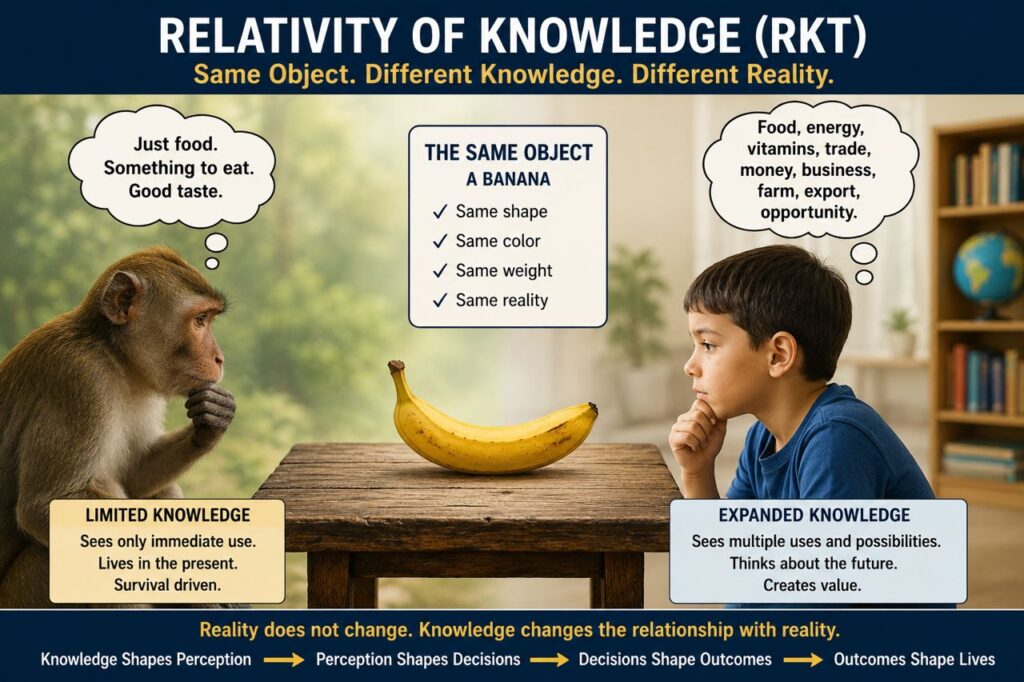
Entrepreneurship is often portrayed as a function of courage, ambition, creativity, or access to capital. While each of these attributes contributes to entrepreneurial success, they do not explain why two individuals living in the same city, possessing similar financial resources, observing the same markets, and facing identical economic conditions frequently arrive at entirely different outcomes. One individual identifies opportunities, establishes businesses, creates employment, and accumulates wealth. The other sees only obstacles, uncertainty, and risk. The difference rarely begins with capital. It begins with knowledge. The Relativity of Knowledge Theory (RKT) argues that entrepreneurship is fundamentally a function of how individuals relate to reality through knowledge. Entrepreneurs are distinguished not because they inhabit different economies, but because they perceive and interpret the same economy differently.
This perspective fundamentally changes how entrepreneurship should be understood. Entrepreneurship is not simply the act of starting a business. It is the intellectual process of recognizing relationships between problems and solutions, between scarcity and opportunity, between unmet demand and value creation. Before every successful business exists, there is first a different way of seeing. That difference is created by knowledge.
The issue extends far beyond the surface.
Every economy continuously generates problems. Transportation delays, housing shortages, food insecurity, inefficient logistics, financial exclusion, inadequate healthcare, weak educational systems, poor waste management, unreliable electricity, and fragmented supply chains are all economic problems. Yet these same problems simultaneously represent economic opportunities. Whether they become burdens or businesses depends upon the knowledge of those observing them. One individual experiences traffic congestion simply as frustration. Another designs a transportation platform. One person sees agricultural waste. Another develops a recycling company. One person views financial exclusion as an unfortunate reality. Another creates a fintech enterprise serving previously ignored communities. Reality remains constant; entrepreneurial knowledge changes the relationship with that reality.
Economic history repeatedly demonstrates this principle. Henry Ford did not invent transportation; he transformed the relationship between ordinary people and transportation through mass production. Steve Jobs did not invent computing; he reimagined the relationship between technology and everyday life. Muhammad Yunus did not invent lending; he redefined how financial systems could relate to low-income entrepreneurs through microfinance. These entrepreneurs succeeded because they perceived possibilities that conventional thinking failed to recognize. Their greatest competitive advantage was not merely capital or technology. It was knowledge that enabled a different perception of opportunity.
Economic development rarely occurs by accident; it is often the result of deliberate strategy.
The world’s most entrepreneurial economies consistently invest in educational systems that cultivate curiosity, critical thinking, experimentation, technical competence, creativity, and problem-solving. Silicon Valley emerged not simply because venture capital was available, but because universities, research institutions, technology firms, investors, and entrepreneurs collectively created an ecosystem where knowledge continuously generated innovation. Israel developed one of the world’s most dynamic startup ecosystems by integrating scientific research, military technology, engineering education, and entrepreneurial finance. South Korea transformed itself from a low-income economy into a global technology leader by deliberately aligning education, industrial policy, research, and manufacturing. These examples demonstrate that entrepreneurship flourishes where knowledge ecosystems flourish.
This observation carries significant implications for Africa. Across the continent, entrepreneurship is frequently promoted as a solution to unemployment. While encouraging business creation remains important, entrepreneurship cannot simply be taught through motivational speeches or short-term training programs. Sustainable entrepreneurship requires knowledge capable of identifying opportunities, understanding markets, managing finance, solving customer problems, adopting technology, building organizations, and adapting continuously to changing economic conditions. Without these foundations, many businesses remain small, informal, and vulnerable despite the determination of their founders.
At its core, this is a structural challenge.
Many educational systems continue preparing students primarily to seek employment rather than to create productive enterprise. Academic success is often measured by examination performance instead of problem-solving capability. Graduates may possess theoretical knowledge while lacking practical understanding of market analysis, customer behavior, innovation, financial management, product development, negotiation, leadership, and business strategy. Consequently, societies may produce thousands of educated individuals but relatively few entrepreneurs capable of building scalable enterprises that generate employment and industrial growth.
The Relativity of Knowledge Theory explains why this occurs. Individuals create businesses according to the opportunities they are capable of perceiving. Perception itself depends upon knowledge. A graduate trained to memorize information without learning to solve problems may overlook opportunities that someone with practical entrepreneurial knowledge immediately recognizes. Entrepreneurship therefore begins long before business registration. It begins with developing the intellectual capacity to interpret problems as opportunities for value creation.
This perspective also reshapes our understanding of risk. Entrepreneurs are frequently described as risk-takers. In reality, successful entrepreneurs are often risk managers rather than reckless gamblers. Knowledge reduces uncertainty by improving judgment. Financial literacy reduces investment mistakes. Market research reduces commercial uncertainty. Engineering knowledge reduces production errors. Legal understanding reduces regulatory risk. Management education improves organizational performance. As knowledge expands, uncertainty becomes increasingly measurable and manageable. Entrepreneurs therefore do not simply become more courageous. They become more informed.
Innovation follows the same principle. Innovation rarely emerges from randomness. It develops through accumulated knowledge combined in new ways. Scientific discoveries, engineering breakthroughs, software development, biotechnology, renewable energy, artificial intelligence, logistics optimization, and manufacturing improvements all depend upon individuals capable of connecting previously unrelated ideas. Knowledge expands the number of possible relationships the human mind can construct. Consequently, societies investing heavily in research, education, and technological capability consistently generate higher levels of innovation and entrepreneurial activity.
The implications extend beyond individual businesses. Entrepreneurship performs a vital economic function by transforming knowledge into productive capacity. Entrepreneurs create employment, expand markets, increase competition, encourage innovation, strengthen supply chains, improve productivity, and generate wealth. They convert ideas into industries and problems into economic opportunities. Every successful enterprise therefore represents applied knowledge operating within the marketplace.
This understanding aligns naturally with the broader frameworks developed throughout my work. Africa Basic Economics (ABE) seeks to strengthen the productive foundations of food, transportation, and housing. Untapped Essential Industries (UEI) identifies strategic sectors capable of producing large economic multiplier effects. Stability, Transparency, and Predictability (STP) reduce institutional friction, encouraging investment and long-term capital formation. Africa Economic Governance (AEG) strengthens institutional coordination, while AFnecon provides a continental strategy for productive transformation. The Relativity of Knowledge Theory serves as the cognitive foundation beneath all these frameworks because none can succeed without individuals capable of recognizing opportunities, designing solutions, managing institutions, and creating value through knowledge.
Perhaps the greatest contribution of entrepreneurship is not wealth itself but transformation. Entrepreneurs continuously reshape economies by changing how societies relate to resources, technology, labor, capital, and markets. They transform idle land into productive agriculture, raw materials into manufactured goods, ideas into software, research into medical innovation, waste into renewable energy, and local businesses into global enterprises. In every case, knowledge precedes transformation.
Ultimately, entrepreneurship demonstrates the central proposition of the Relativity of Knowledge Theory more clearly than almost any other human activity. People do not create businesses because opportunities exist. They create businesses because their knowledge allows them to recognize opportunities that others cannot yet see. Opportunity is therefore not simply discovered; it is perceived through knowledge, refined through learning, and transformed through productive action.
This insight completes the foundation of the Relativity of Knowledge Theory. Throughout this series, we have seen that knowledge shapes perception, employment, society, and entrepreneurship because knowledge shapes the relationship between human beings and reality itself. The quality of our institutions reflects the quality of our knowledge. The strength of our economies reflects the strength of our understanding. The competitiveness of nations reflects the relevance of what they teach, what they learn, and what they continually improve.
The future of Africa, and indeed the future of every nation, will not ultimately be determined by the resources beneath its soil or the capital within its banks. It will be determined by the knowledge within the minds of its people. Nations rise when education expands perception, perception inspires innovation, innovation creates entrepreneurship, entrepreneurship strengthens industry, and industry generates sustainable prosperity. That progression is not accidental. It is the natural consequence of knowledge continuously transforming the way human beings relate to the world around them.
The Relativity of Knowledge Theory therefore offers more than an explanation of education or economics. It offers a philosophy of development. It reminds us that every lasting transformation begins with understanding, every meaningful innovation begins with perception, and every prosperous civilization begins by investing in the limitless productive resource that has always distinguished human progress from mere existence: knowledge.
Leave a Reply