
Volume IV
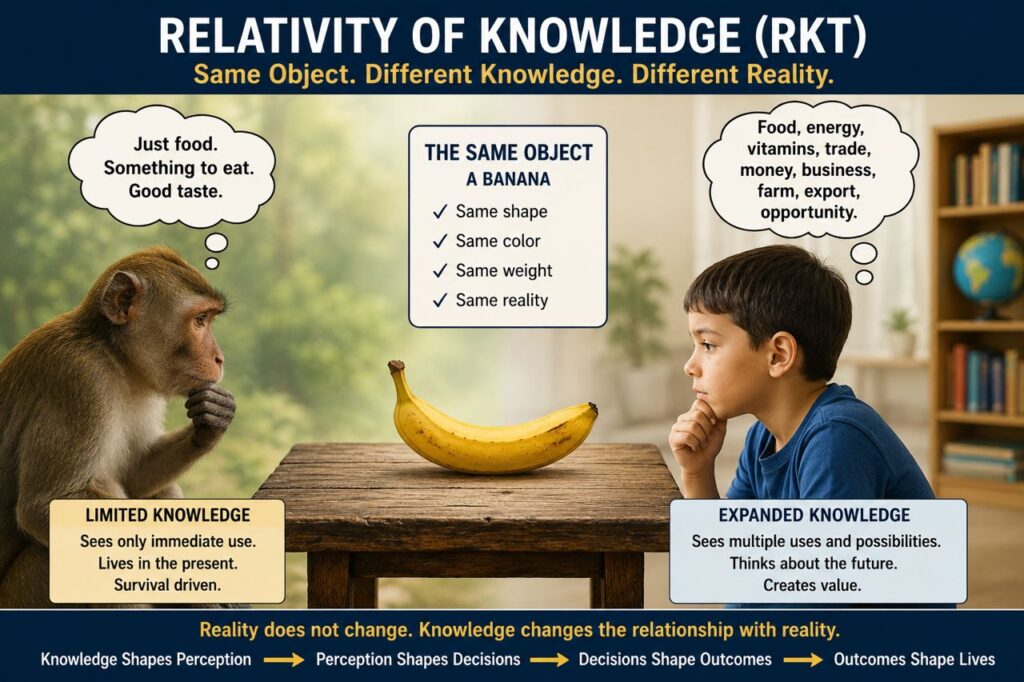
Every society is ultimately a reflection of the knowledge possessed by its people. While geography, natural resources, political institutions, and historical events undoubtedly influence national development, these factors alone cannot explain why societies with similar resources frequently experience vastly different economic, political, and social outcomes. The deeper explanation lies in how people understand their environment, organize their institutions, solve collective problems, and transform available resources into productive systems. At the center of this process is knowledge. The Relativity of Knowledge Theory (RKT) argues that societies evolve according to the quality, depth, relevance, and application of the knowledge held by individuals and institutions. Consequently, the long-term trajectory of any nation depends not merely on what resources it possesses, but on how its people relate to those resources through knowledge.
Society is often viewed as a collection of people living under common institutions, laws, cultures, and traditions. However, beneath these visible structures lies an invisible intellectual foundation. Every law begins as an idea. Every institution reflects accumulated knowledge. Every technological innovation originates from learning. Every successful economy develops through generations of scientific discovery, education, entrepreneurship, and institutional adaptation. The visible outcomes of civilization therefore represent the cumulative application of knowledge across multiple generations. Roads, hospitals, universities, financial systems, industries, governments, and markets are not merely physical structures; they are organized expressions of human understanding.
The issue extends far beyond the surface.
Human beings do not collectively organize society according to instinct alone. They organize society according to what they know. A society that understands sanitation develops public health systems. A society that understands engineering builds reliable infrastructure. A society that understands economics creates productive financial institutions. A society that understands technology invests in research, innovation, and industrial competitiveness. Conversely, societies operating with outdated, incomplete, or irrelevant knowledge frequently struggle to design institutions capable of supporting long-term development. Institutional weakness therefore often reflects knowledge weakness before it becomes an administrative problem.
History repeatedly demonstrates this relationship. The Industrial Revolution fundamentally transformed Europe not simply because new machines were invented, but because scientific knowledge increasingly became integrated into production, manufacturing, transportation, and commerce. The rapid rise of Japan after the Meiji Restoration reflected a deliberate national commitment to acquiring and adapting global scientific, industrial, and educational knowledge. South Korea and Singapore similarly transformed themselves by investing heavily in education, technological capability, institutional competence, and human capital. Their greatest resource was not land or minerals. It was knowledge systematically organized into productive national systems.
Economic development rarely occurs by accident; it is often the result of deliberate strategy.
This principle carries profound implications for Africa. Much of the continent possesses extraordinary natural wealth, youthful populations, entrepreneurial energy, and expanding domestic markets. Yet significant portions of this potential remain unrealized because educational systems, institutional structures, and governance frameworks frequently struggle to produce knowledge directly connected to productive economic transformation. Many students graduate with academic qualifications but limited exposure to industrial processes, technological innovation, scientific research, entrepreneurship, manufacturing, logistics, or global competitiveness. The result is not simply graduate unemployment. It is a society whose intellectual resources become only partially connected to its economic resources.
Knowledge shapes more than employment. It shapes culture itself. Cultural attitudes toward entrepreneurship, innovation, savings, investment, education, scientific inquiry, civic responsibility, and public accountability all emerge from collectively shared knowledge. Where societies understand the importance of long-term investment, capital formation expands. Where scientific thinking becomes embedded within education, innovation accelerates. Where civic education strengthens public responsibility, institutions generally become more accountable. Knowledge therefore influences not only individual behavior but also the collective norms governing society.
Governance illustrates this relationship particularly well. Governments formulate policies according to their understanding of economic and social systems. Legislators draft laws according to their interpretation of institutional needs. Public administrators implement programs based upon their professional knowledge and technical competence. Consequently, governance quality depends heavily upon knowledge quality. Corruption, inefficient bureaucracy, inconsistent policy implementation, and institutional weakness often reflect deficiencies in knowledge, organizational learning, professional ethics, or administrative capability. While political factors undoubtedly contribute, lasting institutional reform requires strengthening the knowledge systems upon which governance itself depends.
This perspective also explains why misinformation can become economically destructive. Societies increasingly operate within information-rich environments where ideas spread rapidly through digital technologies and social media. However, greater access to information does not automatically produce greater understanding. Information becomes socially valuable only when individuals possess the knowledge necessary to evaluate evidence critically, distinguish facts from opinion, and make informed decisions. Educational systems therefore perform an increasingly important role in developing critical thinking rather than simply transmitting information. The ability of society to resist misinformation depends largely upon the quality of knowledge cultivated within schools, universities, research institutions, and public discourse.
The Relativity of Knowledge Theory also offers a different understanding of inequality. Economic inequality is often analyzed through income, wealth, employment, or access to public services. These measures remain important, yet beneath them lies another dimension: inequality in knowledge. Individuals possessing higher-quality education, stronger technical skills, broader professional networks, and greater access to information generally perceive and exploit opportunities unavailable to others. Knowledge therefore influences economic mobility by determining how effectively individuals relate to markets, technology, finance, entrepreneurship, and innovation. Reducing long-term inequality consequently requires expanding access to relevant, high-quality knowledge rather than merely redistributing financial resources.
Technology further reinforces this principle. Artificial intelligence, biotechnology, renewable energy, robotics, advanced manufacturing, and digital finance are rapidly reshaping global economic competition. Societies that understand these technologies become producers of innovation. Those lacking sufficient knowledge increasingly become consumers of technologies developed elsewhere. The difference is not technological destiny. It is educational preparedness. Knowledge determines whether societies lead technological revolutions or merely adapt to them after others have established competitive advantage.
At its core, this is a structural challenge.
Many development debates focus on infrastructure, foreign investment, natural resources, or government expenditure. These factors undoubtedly matter, but they represent outputs of deeper knowledge systems. Infrastructure is designed through engineering knowledge. Investment decisions depend upon financial knowledge. Industrialization requires scientific and technical knowledge. Institutional effectiveness reflects administrative knowledge. Competitiveness emerges from organizational, technological, and entrepreneurial knowledge. Strengthening society therefore begins by strengthening the intellectual foundations from which these outcomes emerge.
This insight aligns closely with the broader frameworks developed throughout my work. Africa Basic Economics (ABE) emphasizes that affordable food, transportation, and housing provide the foundation for productive economic participation. Stability, Transparency, and Predictability (STP) reduce institutional friction, encouraging investment and long-term planning. Untapped Essential Industries (UEI) identify sectors capable of generating significant multiplier effects across the economy. Africa Economic Governance (AEG) focuses on institutional effectiveness as the operating system of development. The Relativity of Knowledge Theory provides the cognitive foundation beneath each of these frameworks. None can function effectively without knowledge capable of understanding, implementing, and continuously improving them.
Societies therefore become living expressions of collective knowledge. They educate according to what they value, govern according to what they understand, innovate according to what they imagine, and develop according to what they are capable of organizing. The quality of institutions cannot consistently exceed the quality of the knowledge supporting them. Likewise, sustainable national transformation cannot occur independently of educational transformation.
Ultimately, the future of every society depends less upon the challenges it faces than upon the knowledge it possesses to overcome those challenges. History consistently demonstrates that civilizations rise when knowledge expands faster than problems. They stagnate when problems outpace understanding. The central lesson of the Relativity of Knowledge Theory is therefore clear: to shape society is first to shape knowledge. By investing in education that develops critical thinking, scientific reasoning, technological competence, entrepreneurial capability, and institutional understanding, societies expand their ability to perceive opportunities, solve increasingly complex problems, and organize themselves for long-term prosperity. Knowledge does not merely influence society; over time, it becomes society.
Leave a Reply