
Volume III
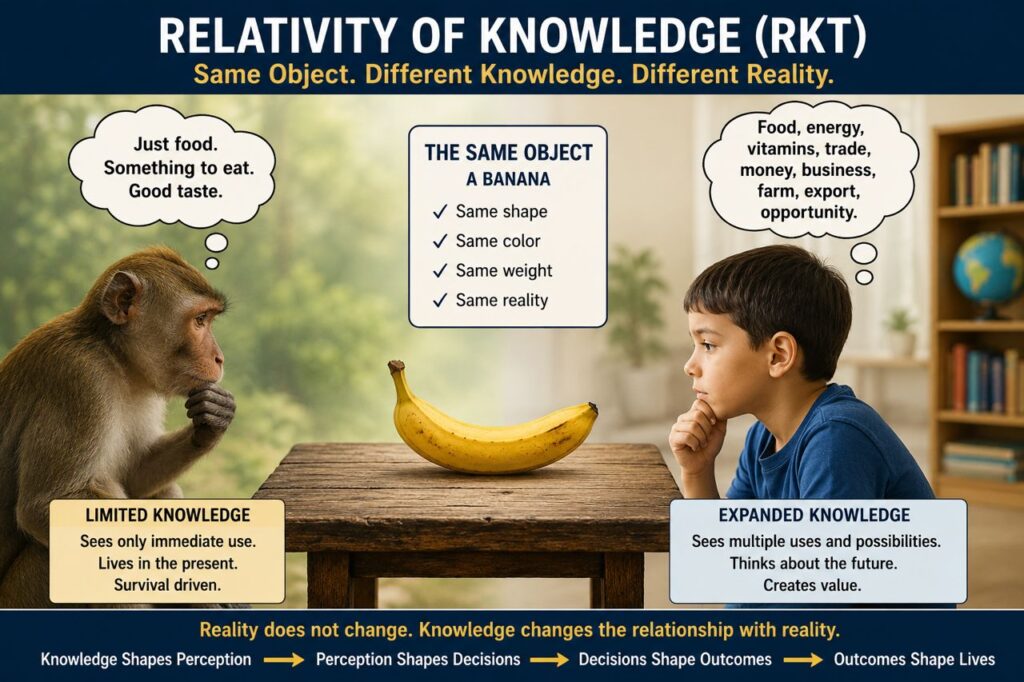
Human beings rarely respond to reality exactly as it exists. Instead, they respond to their understanding of reality. Two people may witness the same event, observe the same object, inherit the same environment, or confront the same problem, yet arrive at entirely different conclusions and make completely different decisions. The difference is not necessarily found in reality itself but in the knowledge through which reality is interpreted. This simple observation forms one of the central principles of the Relativity of Knowledge Theory (RKT): human perception is relative to knowledge. Knowledge does not merely provide information; it shapes interpretation, determines meaning, influences judgment, and ultimately directs human behavior. Consequently, perception is not simply a biological process of seeing or hearing. It is an intellectual process of understanding.
For centuries, philosophers attempted to explain why individuals perceive the world differently. Modern cognitive science has provided increasingly compelling answers. The human brain is not a passive recorder of information. Rather, it actively interprets incoming information using previous knowledge, experience, memory, beliefs, education, and learned mental models. Neuroscientists describe perception as a constructive process in which the brain continually predicts, filters, and organizes sensory information into meaningful patterns. What individuals recognize therefore depends not only on what exists before them but also on what their minds have been prepared to recognize. Learning changes the brain itself by strengthening neural connections, allowing individuals to identify relationships and patterns that previously remained invisible (Kolb & Whishaw, 2021).
This explains why knowledge fundamentally changes reality without altering the physical world itself.
Imagine placing a complex financial statement before three individuals. The first has no financial education. The second is an accounting student. The third is an experienced investment analyst. Although all three observe the same document, each experiences a different reality. The first sees confusing numbers. The second recognizes accounting principles and organizational structure. The third immediately identifies profitability trends, liquidity risks, debt exposure, operational efficiency, investment opportunities, and future earnings potential. The financial statement has not changed. The relationship between the observer and the document has changed because knowledge has changed.
The issue extends far beyond the surface.
This principle governs nearly every aspect of human civilization. A physician observes symptoms differently from an ordinary patient because medical knowledge changes clinical perception. An architect interprets buildings differently from a tourist because professional knowledge reveals structural relationships invisible to others. A software engineer understands computer systems differently from someone who merely uses technology. A military strategist interprets geopolitical developments differently from an average citizen. Knowledge consistently expands the ability to perceive complexity, recognize patterns, anticipate consequences, and make informed decisions.
Entrepreneurship provides one of the clearest illustrations of this theory. Markets present identical conditions to millions of people every day, yet only a relatively small number recognize business opportunities capable of generating wealth. The entrepreneur does not inhabit a different world. Rather, the entrepreneur relates differently to the same world. Where others see inconvenience, the entrepreneur sees unmet demand. Where others encounter waste, the entrepreneur identifies raw materials for a new industry. Where others experience inefficiency, the entrepreneur recognizes commercial opportunity. This difference is fundamentally cognitive before it becomes financial. It originates from knowledge that enables one individual to perceive economic relationships invisible to others.
Economic development rarely occurs by accident; it is often the result of deliberate strategy.
The same principle explains why nations industrialize at different rates despite possessing comparable natural resources. Countries do not simply discover development; they perceive possibilities differently because institutions, education systems, research capacity, and accumulated knowledge shape national decision-making. Japan transformed limited natural resources into advanced manufacturing because its institutions perceived knowledge as a productive asset. South Korea recognized education as industrial infrastructure rather than merely social policy. Singapore viewed geographic limitations not as barriers but as incentives for building one of the world’s most efficient logistics and financial systems. Their development strategies reflected different perceptions of possibility, and those perceptions emerged from knowledge rather than circumstance alone.
This relationship extends directly into governance. Policymakers frequently confront identical economic problems while proposing radically different solutions. One government may respond to unemployment by expanding public employment. Another may prioritize industrialization. A third may encourage entrepreneurship, while a fourth invests heavily in education and innovation. Each policy reflects a different perception of the underlying problem. Governance therefore becomes an expression of collective knowledge. The quality of national decision-making depends largely upon the quality of knowledge informing public institutions.
The Relativity of Knowledge Theory suggests that corruption, institutional weakness, and ineffective governance often reflect deeper knowledge deficiencies rather than purely moral failures. Leaders can only formulate policies according to their understanding of economic systems. Institutions perform according to the knowledge embedded within their structures. Societies therefore cannot consistently produce governance that exceeds the quality of knowledge possessed by those responsible for governing. Improving institutions consequently requires improving the knowledge that shapes institutional behavior.
Technology further demonstrates how perception evolves alongside knowledge. Artificial intelligence, for example, is interpreted very differently across society. Some individuals perceive it primarily as a threat to employment. Others recognize it as an opportunity for productivity growth, scientific advancement, business innovation, and industrial competitiveness. Technology itself remains unchanged. What differs is the knowledge through which technology is understood. This difference increasingly determines which countries become technology producers and which remain technology consumers.
The labor market follows the same pattern. A graduate possessing outdated knowledge may perceive limited employment opportunities because available industries appear incompatible with existing skills. Another graduate, equipped with updated technical knowledge and entrepreneurial thinking, may identify numerous opportunities within the same economy. Their environments remain identical. Their perceptions differ because their knowledge differs. Employment therefore depends not only upon labor demand but also upon the capacity of individuals to perceive where value can be created.
This insight carries profound implications for education. Educational institutions should not merely transfer information. Their greater responsibility is expanding human perception. Effective education teaches students to identify relationships between disciplines, connect theory with practice, recognize emerging opportunities, evaluate evidence critically, solve increasingly complex problems, and adapt continuously to changing environments. Education succeeds when it changes how individuals perceive reality, not merely what they remember about it.
Scientific progress itself illustrates this principle. Before Isaac Newton, falling apples represented ordinary daily events. Newton perceived universal laws governing motion and gravity. Before Alexander Fleming, contaminated laboratory cultures were experimental failures. Fleming perceived the discovery of penicillin. Before the founders of Google, the rapidly expanding internet represented information overload. They perceived a revolutionary method for organizing the world’s knowledge. Great discoveries frequently emerge not because extraordinary realities suddenly appear but because extraordinary perception reveals possibilities hidden within ordinary reality.
Business leadership depends upon similar cognitive capabilities. Successful executives consistently recognize patterns before competitors, anticipate market shifts, interpret customer behavior, evaluate technological disruption, and identify strategic risks long before they become obvious. Leadership therefore represents applied perception informed by knowledge. The ability to make superior decisions depends fundamentally upon the ability to perceive reality more accurately than others.
At its core, this is a structural challenge.
Human progress depends less upon changing reality than upon improving humanity’s relationship with reality. Agriculture transformed wilderness into food systems because knowledge altered perception. Medicine transformed disease management because scientific understanding expanded. Industrialization transformed raw materials into manufacturing because engineering knowledge advanced. Digital technology transformed information into economic infrastructure because computer science redefined human interaction with knowledge itself. Every major advancement in civilization began when knowledge reshaped perception.
The Relativity of Knowledge Theory therefore proposes that perception functions as the bridge between knowledge and action. Knowledge shapes perception. Perception shapes decisions. Decisions shape behavior. Behavior shapes institutions, businesses, technologies, governments, and economies. Consequently, improving perception begins with improving knowledge.
Ultimately, societies become limited not only by the resources they possess but by the realities they are capable of perceiving. The greatest opportunities often remain invisible until knowledge reveals them. Likewise, the greatest risks frequently remain unnoticed until understanding catches up with changing circumstances. Human civilization advances because knowledge continually expands the boundaries of perception, allowing each generation to recognize possibilities that previous generations could neither imagine nor pursue.
The central lesson of this volume is therefore straightforward yet profound: people do not merely see the world as it is; they see the world as their knowledge allows them to understand it. The future of individuals, businesses, institutions, and nations will increasingly depend not simply upon acquiring more information but upon developing richer, deeper, and more relevant knowledge capable of transforming perception into productive action. That is the enduring relationship between knowledge and human reality, and it stands at the heart of the Relativity of Knowledge Theory.
Leave a Reply