
Volume II
For decades, unemployment has been analyzed primarily through economic indicators such as population growth, business cycles, investment levels, industrialization, government policy, and labor market conditions. These factors undoubtedly influence employment outcomes, yet they often explain only the external conditions under which unemployment exists. They do not fully explain why individuals living within the same economy, exposed to similar opportunities, frequently experience remarkably different employment outcomes. Some graduates secure meaningful careers, others remain unemployed for years, some establish successful businesses, while others drift into informal employment or even criminal activity. The difference often lies not merely in the availability of opportunities but in the relationship between knowledge and opportunity. This chapter argues that unemployment should not be understood solely as an economic problem. It is also a knowledge problem.
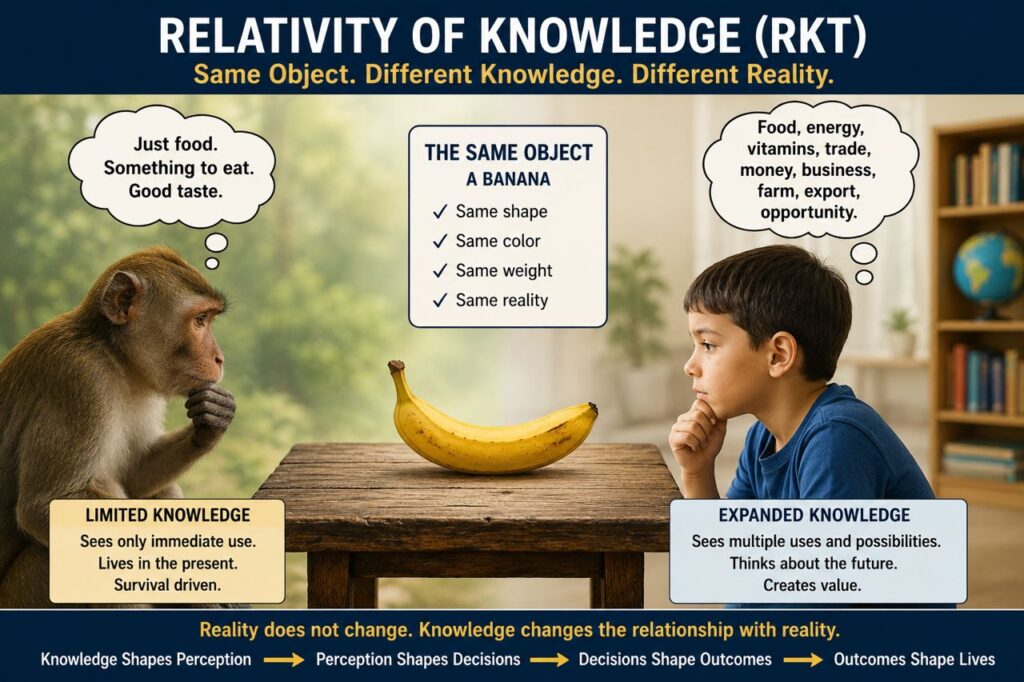
The Relativity of Knowledge Theory proposes that people relate to economic opportunities according to the quality, depth, relevance, and application of the knowledge they possess. Employment is fundamentally a relationship between human capability and economic demand. Whenever this relationship weakens, unemployment increases. Consequently, unemployment cannot be explained simply by counting available jobs or graduates. It must also be understood by examining whether education equips individuals with knowledge that enables them to recognize opportunities, solve productive problems, adapt to technological change, and create economic value.
The issue extends far beyond the surface.
Modern economies are increasingly knowledge-driven. Employers no longer recruit workers solely because they possess academic qualifications. They recruit individuals capable of applying knowledge to improve productivity, solve organizational challenges, innovate, communicate effectively, and adapt to rapidly changing industries. A university degree therefore represents only one stage of development. Its economic value depends entirely upon the relevance of the knowledge and competencies it develops. A graduate possessing extensive theoretical knowledge but limited practical capability may struggle within the labor market despite years of formal education. Conversely, another individual with fewer academic credentials but stronger practical understanding, technical competence, and entrepreneurial thinking may generate significant economic value.
This distinction explains one of Africa’s most persistent development challenges. Across many African countries, universities continue producing thousands of graduates annually, yet graduate unemployment remains persistently high. According to the International Labour Organization, young people consistently experience significantly higher unemployment rates than older workers, particularly in developing economies where education systems frequently struggle to keep pace with labor-market transformation. Youth unemployment reflects not only insufficient job creation but also a growing mismatch between educational outcomes and the skills demanded by modern economies.
Knowledge therefore possesses two dimensions that education frequently confuses: acquisition and application. Students may successfully memorize theories, definitions, formulas, and historical information while remaining unable to apply that knowledge within real economic environments. Businesses, however, compensate application rather than memorization. Markets reward individuals capable of transforming knowledge into solutions, productivity, innovation, efficiency, and value creation.
Economic development rarely occurs by accident; it is often the result of deliberate strategy.
Countries that successfully reduced unemployment rarely achieved this objective merely by increasing university enrollment. Instead, they transformed education into an extension of national economic strategy. Germany’s dual vocational training system integrates classroom learning with industrial apprenticeship. South Korea continually aligned educational investment with manufacturing, engineering, electronics, and technological development during its industrial transformation. Singapore systematically adapted its education system to evolving industrial priorities, enabling workers to transition alongside technological change. These countries understood that education functions most effectively when it continuously evolves alongside economic development rather than independently from it. Their educational institutions became productive infrastructure supporting industrial competitiveness rather than isolated academic systems.
Africa’s challenge differs fundamentally. In many countries, educational institutions continue emphasizing examination performance while devoting comparatively less attention to industrial capability, entrepreneurship, technological adaptation, manufacturing, logistics, research, innovation, and practical problem-solving. Graduates often enter labor markets possessing qualifications yet lacking direct relationships with the productive economy. This disconnect gradually produces structural unemployment, where available labor no longer matches available opportunities.
The consequences extend beyond unemployment statistics.
When graduates remain economically disconnected from productive opportunities, many eventually redirect their abilities toward survival activities unrelated to their education. Engineers may enter retail trading. Agricultural graduates may remain unemployed despite enormous agricultural potential. Business graduates may lack entrepreneurial capability despite studying management. Lawyers, accountants, scientists, and technology graduates may abandon their professions because existing knowledge no longer connects effectively with economic opportunity. In some cases, prolonged exclusion contributes to participation in fraudulent financial schemes, cybercrime, illegal extraction activities, or other informal economic practices. While criminal behavior results from numerous social, institutional, and economic factors, weak integration between education and productive opportunity can increase vulnerability by reducing legitimate pathways toward economic participation.
The problem therefore is not that Africa produces graduates.
The problem is that educational systems frequently produce graduates whose knowledge relates more effectively to examinations than to economies.
At its core, this is a structural challenge.
Educational quality should not be measured solely by graduation rates, examination scores, or university rankings. It should also be evaluated by its ability to strengthen productive relationships between graduates and economic systems. Can graduates contribute immediately to manufacturing? Can they improve agricultural productivity? Can they develop software? Can they establish businesses? Can they solve engineering problems? Can they strengthen supply chains? Can they innovate within healthcare? Can they adapt to artificial intelligence and digital transformation? These questions measure educational relevance more effectively than certificates alone.
This perspective becomes increasingly important as global labor markets undergo rapid technological transformation. Artificial intelligence, automation, robotics, biotechnology, renewable energy, advanced manufacturing, and digital finance are redefining the knowledge demanded by employers worldwide. Educational systems incapable of adapting to these changes risk producing graduates prepared for economies that no longer exist. Consequently, unemployment increasingly reflects not only labor-market weakness but also educational inertia.
The Relativity of Knowledge Theory therefore reframes unemployment as a relationship problem rather than merely a labor-market problem. Individuals do not simply compete for jobs. They compete through the knowledge they possess and the value that knowledge enables them to create. Employment emerges when knowledge successfully relates to economic demand. Unemployment emerges when that relationship weakens or disappears.
This insight carries important implications for public policy. Governments seeking sustainable employment should invest not only in job creation but also in educational transformation. Universities should strengthen partnerships with industries. Technical education should receive greater strategic attention. Entrepreneurship should become a central educational objective rather than an optional subject. Research should increasingly address local productive challenges. Industrial policy and educational policy should evolve together rather than separately. Knowledge becomes economically valuable only when connected to productive systems capable of utilizing it.
The same principle applies to individuals. Lifelong learning becomes increasingly essential because economic relationships continually evolve. Knowledge that created employment twenty years ago may no longer produce comparable opportunities today. Continuous learning therefore allows individuals to maintain relevant relationships with changing technologies, industries, markets, and institutions. Employability becomes less dependent upon possessing one qualification and more dependent upon continually expanding one’s capacity to relate knowledge to emerging economic realities.
Ultimately, unemployment is rarely explained by a single variable. Macroeconomic conditions, investment, industrialization, infrastructure, governance, technological change, and demographic growth all influence labor markets. Yet beneath these factors lies a deeper relationship. Human beings create economic value only through knowledge that connects effectively with productive opportunity. The stronger that relationship becomes, the greater employment, productivity, entrepreneurship, innovation, and national competitiveness will be.
The Relativity of Knowledge Theory therefore offers a different perspective on unemployment. Rather than asking only, “Where are the jobs?” it first asks, “How well does our knowledge relate to the opportunities our economy creates?” Sustainable employment begins when education develops minds capable not merely of acquiring information but of recognizing opportunities, solving problems, creating value, and participating meaningfully in the continuous transformation of the economy.
Leave a Reply