
Volume I
A Universal Theory of Productive Systems
Every productive system in existence operates under one universal law: movement creates friction. Whether in physics, engineering, biology, economics, finance, business, or governance, no system can generate motion, perform work, or create value without encountering resistance. Friction is therefore neither an accident nor an imperfection. It is a natural consequence of interaction. The challenge facing every system is not how to eliminate friction altogether, but how to manage it intelligently.
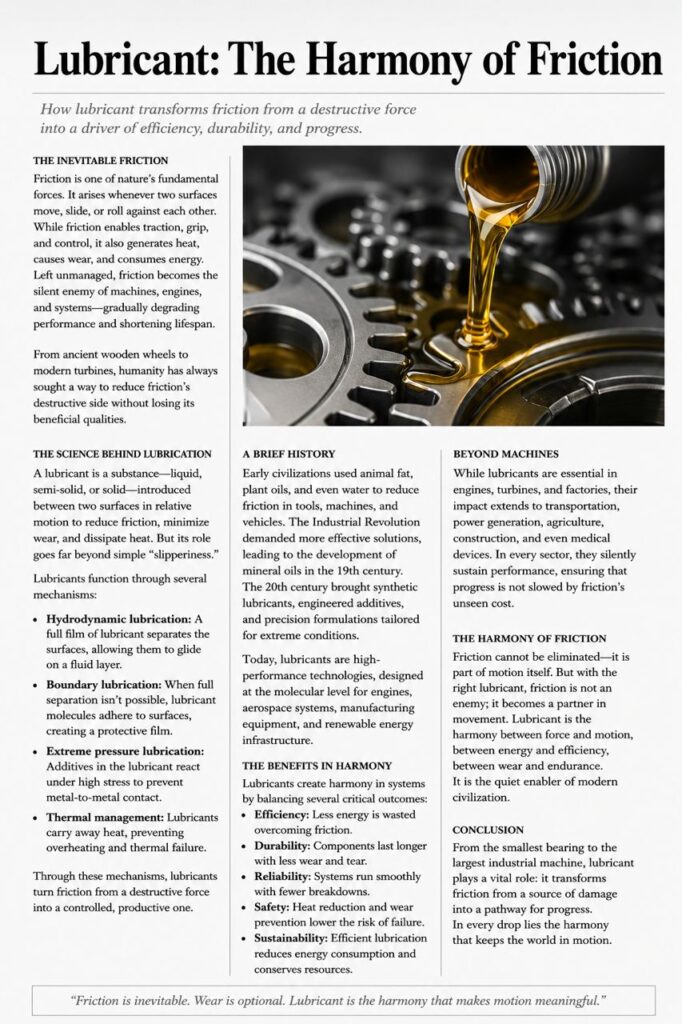
This simple engineering principle has shaped human civilization for thousands of years. Long before the Industrial Revolution transformed manufacturing, ancient civilizations recognized that reducing unnecessary friction improved productivity. Early builders lubricated sledges to move enormous stones. Farmers reduced resistance between tools and soil. Mill operators understood that properly maintained bearings allowed machinery to operate longer with less energy. Engineers eventually developed increasingly sophisticated lubricants capable of reducing wear, dissipating heat, protecting surfaces, and extending the lifespan of machines operating under extraordinary pressure. Today, modern civilization depends upon lubrication systems that quietly sustain automobiles, aircraft, power plants, factories, ships, turbines, robots, and countless industrial processes.
Yet while humanity has mastered the science of lubrication in machines, it has devoted comparatively little attention to applying the same principle to organizations, economies, financial markets, governments, and societies. This paper proposes that the concept of lubrication extends far beyond mechanical engineering. It represents a universal framework for understanding how productive systems sustain efficiency, preserve value, and achieve long-term resilience. In this broader sense, lubricant becomes more than a physical substance. It becomes a philosophy of productive systems.
The issue extends far beyond the surface.
When engineers study friction, they recognize that it performs two seemingly contradictory functions. On one hand, friction is indispensable. Without friction, vehicles cannot accelerate, aircraft cannot land safely, machinery cannot transfer power, and people cannot even walk. Friction enables traction, control, precision, and stability. On the other hand, unmanaged friction consumes energy, generates excessive heat, accelerates wear, shortens equipment life, increases maintenance costs, and ultimately leads to system failure. The engineering objective has therefore never been to abolish friction entirely. Rather, it has been to preserve useful friction while minimizing destructive friction.
This distinction offers profound lessons for economics and institutional development.
Every productive economy contains friction. Markets involve negotiation. Businesses manage competition. Investors evaluate uncertainty. Governments administer regulations. Financial institutions assess risk. Supply chains coordinate thousands of interconnected activities across multiple countries. None of these systems operate without resistance. The question is not whether friction exists. The question is whether that friction contributes to productive coordination or unnecessary inefficiency.
Mechanical engineering provides remarkable clarity on this principle. Lubricants operate by separating moving surfaces, reducing direct contact, minimizing wear, carrying away heat, preventing corrosion, and maintaining stable operating conditions. These functions preserve energy that would otherwise be wasted overcoming unnecessary resistance. Consequently, machines operate more efficiently, consume less energy, require fewer repairs, and produce greater output over longer periods.
Economies exhibit remarkably similar behavior.
Consider two manufacturing firms producing identical products using comparable technologies. One operates within an environment characterized by transparent regulations, reliable electricity, efficient logistics, accessible financing, predictable taxation, and trustworthy institutions. The other operates where regulations change unpredictably, infrastructure remains unreliable, corruption increases transaction costs, financing is prohibitively expensive, contracts are inconsistently enforced, and information remains opaque. Although both firms possess similar productive capabilities, their performance differs substantially because one operates within a well-lubricated institutional environment while the other continually loses productive energy overcoming systemic friction.
From an economic perspective, this wasted energy appears as higher operating costs, delayed investment, reduced competitiveness, slower innovation, declining productivity, and weaker profitability. Resources that should finance expansion instead finance adaptation. Time that should support innovation becomes consumed managing uncertainty. Capital that should purchase new equipment becomes diverted toward overcoming institutional obstacles. The system continues functioning, but far below its productive potential.
Economic development rarely occurs by accident; it is often the result of deliberate strategy.
Throughout history, successful civilizations have consistently reduced unnecessary friction within productive systems. The Roman Empire developed standardized roads that lowered transportation costs across vast territories. The Industrial Revolution introduced interchangeable parts, standardized manufacturing, and increasingly sophisticated machinery that dramatically improved industrial efficiency. The twentieth century witnessed containerization, computerized logistics, global telecommunications, and digital financial systems, each reducing friction within international trade. More recently, artificial intelligence promises to reduce decision-making costs, optimize supply chains, improve resource allocation, and increase productivity across virtually every sector of the global economy.
Each innovation shares a common objective.
Reduce friction.
Increase productive motion.
Preserve valuable energy.
This observation suggests that economic progress itself can be understood as the continuous reduction of unnecessary resistance within productive systems.
Businesses intuitively recognize this principle. Companies invest heavily in process optimization because operational friction directly reduces profitability. Manufacturers redesign production lines to eliminate inefficiencies. Financial institutions automate transactions to reduce administrative delays. Logistics companies optimize delivery routes to minimize transportation costs. Software developers simplify user interfaces to reduce customer effort. Hospitals streamline patient workflows. Universities digitize administrative processes. Every organization seeking higher productivity ultimately attempts to identify and remove unnecessary friction.
National economies operate similarly.
Infrastructure functions as a lubricant because it reduces transportation resistance. Financial systems lubricate capital allocation by connecting savings with productive investment. Legal institutions lubricate commerce through contract enforcement. Education lubricates innovation by strengthening human capital. Technology lubricates production through automation and efficiency. Stable monetary systems lubricate exchange by preserving purchasing power. Transparent governance lubricates investment by reducing uncertainty. Each performs a distinct function, yet all contribute toward the same objective: allowing productive activity to occur with fewer unnecessary obstacles.
Conversely, corruption behaves like abrasive contamination within machinery. Instead of reducing friction, it increases it. Businesses devote additional resources to navigating opaque procedures. Investors incorporate higher risk premiums into financial decisions. Public projects become more expensive while producing lower-quality outcomes. Institutional trust deteriorates. Productive energy dissipates through inefficiency rather than value creation. Like contaminated lubricant within an engine, corruption gradually accelerates institutional wear until the system itself becomes increasingly unreliable.
This analogy extends even further.
Machines require periodic maintenance because lubricants degrade over time. Economic institutions require continual reform for precisely the same reason. Laws become outdated. Regulations lose effectiveness. Infrastructure deteriorates. Technologies evolve. Global markets change. Without institutional renewal, friction gradually accumulates until productivity declines despite unchanged productive capacity. Nations that consistently modernize institutions maintain smoother economic operation than those allowing institutional deterioration to continue unchecked.
Investment itself can also be interpreted through this framework.
Professional investors continuously seek environments where productive energy encounters minimal unnecessary resistance. They evaluate infrastructure quality, legal certainty, regulatory consistency, governance standards, financial stability, technological capability, and workforce productivity because each influences the amount of friction businesses must overcome before generating returns. Investors rarely describe this process using engineering terminology, yet their behavior reflects precisely the same principle. Capital flows toward well-lubricated systems.
This observation fundamentally changes how competitiveness should be understood.
Competitiveness is not merely determined by lower wages, larger markets, or abundant natural resources. It increasingly depends upon the degree of institutional friction embedded within an economy. Two countries may possess identical resource endowments, similar populations, and comparable market sizes, yet produce dramatically different economic outcomes because one has systematically reduced unnecessary resistance while the other continues operating within highly inefficient institutional structures.
The implications become especially important for developing economies.
Many countries possess extraordinary entrepreneurial talent, abundant natural resources, expanding consumer markets, and favorable demographic conditions. Yet these advantages alone cannot guarantee prosperity if productive systems remain burdened by excessive friction. Entrepreneurs struggle despite promising ideas. Manufacturers remain internationally uncompetitive despite abundant labor. Infrastructure projects exceed budgets while delivering limited performance. Financial systems fail to allocate capital efficiently. Public institutions consume increasing resources while producing declining effectiveness. Productive potential exists, but friction prevents its realization.
This insight forms the foundation of what I call The Lubrication Theory of Economic Development.
The theory proposes that sustainable economic transformation depends not merely upon increasing resources but upon continuously reducing unnecessary friction across productive systems. Development therefore becomes the process of identifying where resistance destroys value and designing institutions capable of managing that resistance more intelligently. Just as lubrication allows machines to preserve energy for productive work, effective institutions preserve economic energy for innovation, investment, industrialization, entrepreneurship, and wealth creation.
Ultimately, civilization itself can be interpreted through this lens. Every major advancement—from the invention of the wheel to modern artificial intelligence—has reduced friction somewhere within the human productive system. Roads reduced transportation friction. Electricity reduced production friction. Telecommunications reduced information friction. Banking reduced financial friction. The internet reduced communication friction. Artificial intelligence now promises to reduce cognitive friction. Human progress has consistently advanced through the intelligent management of resistance.
Friction is therefore not the enemy of progress.
Unmanaged friction is.
Likewise, lubricant is far more than a mechanical substance. It represents one of humanity’s most important organizational principles. It transforms resistance into coordination, preserves productive capacity, extends system life, improves efficiency, and enables continuous motion under pressure. Whether applied to machines, businesses, financial markets, governments, or entire economies, the principle remains remarkably consistent.
The world’s most successful systems are rarely those that eliminate friction entirely. They are the ones that understand it, manage it, and transform it into productive movement. That, ultimately, is the harmony of friction.
Leave a Reply